

CIPT Exam Questions Dumps, Selling IAPP Products
CIPT Cert Guide PDF 100% Cover Real Exam Questions
NEW QUESTION # 97
What is the main reason a company relies on implied consent instead of explicit consent from a user to process her data?
- A. An explicit consent model is more expensive to implement.
- B. The implied consent model provides the user with more detailed data collection information.
- C. To secure explicit consent, a user's website browsing would be significantly disrupted.
- D. Regulators prefer the implied consent model.
Answer: C
Explanation:
Implied consent is often used instead of explicit consent in certain contexts because obtaining explicit consent can be disruptive to the user experience. Explicit consent usually requires the user to perform an additional action, such as clicking a checkbox or filling out a form, which can interrupt their activity on the website. This disruption can lead to a negative user experience and potentially a decrease in user engagement. The IAPP guidelines emphasize the balance between user experience and the need for consent, noting that implied consent can be sufficient in situations where it is clear that the user understands and agrees to the data processing (IAPP, "Privacy by Design and Default").
NEW QUESTION # 98
An organization must terminate their cloud vendor agreement immediately. What is the most secure way to delete the encrypted data stored in the cloud?
- A. Invoke the appropriate deletion clause in the cloud terms and conditions.
- B. Destroy all encryption keys associated with the data.
- C. Transfer the data to another location.
- D. Obtain a destruction certificate from the cloud vendor.
Answer: B
Explanation:
Destroying all encryption keys associated with encrypted data stored on a cloud server would make that encrypted data inaccessible even if it still exists on that server 4.
NEW QUESTION # 99
What is the best way to protect privacy on a geographic information system (GIS)?
- A. Using a firewall.
- B. Using a wireless encryption protocol.
- C. Limiting the data provided to the system.
- D. Scrambling location information.
Answer: C
NEW QUESTION # 100
SCENARIO
Please use the following to answer the next question:
Light Blue Health (LBH) is a healthcare technology company developing a new web and mobile application that collects personal health information from electronic patient health records. The application will use machine learning to recommend potential medical treatments and medications based on information collected from anonymized electronic health records. Patient users may also share health data collected from other mobile apps with the LBH app.
The application requires consent from the patient before importing electronic health records into the application and sharing it with their authorized physicians or healthcare provider. The patient can then review and share the recommended treatments with their physicians securely through the app. The patient user may also share location data and upload photos in the app. The patient user may also share location data and upload photos in the app for a healthcare provider to review along with the health record. The patient may also delegate access to the app.
LBH's privacy team meets with the Application development and Security teams, as well as key business stakeholders on a periodic basis. LBH also implements Privacy by Design (PbD) into the application development process.
The Privacy Team is conducting a Privacy Impact Assessment (PIA) to evaluate privacy risks during development of the application. The team must assess whether the application is collecting descriptive, demographic or any other user related data from the electronic health records that are not needed for the purposes of the application. The team is also reviewing whether the application may collect additional personal data for purposes for which the user did not provide consent.
What is the best way to minimize the risk of an exposure violation through the use of the app?
- A. Prevent the downloading of photos stored in the app.
- B. Create a policy to prevent combining data with external data sources.
- C. Dissociate the patient health data from the personal data.
- D. Exclude the collection of personal information from the health record.
Answer: C
Explanation:
By dissociating patient health data from personal data, Light Blue Health can help reduce the risk of an exposure violation. This can help prevent sensitive health information from being linked to an individual's identity and reduce the potential harm that could result from a privacy breach.
NEW QUESTION # 101
What can be used to determine the type of data in storage without exposing its contents?
- A. Server logs.
- B. Metadata.
- C. Data mapping.
- D. Collection records.
Answer: B
Explanation:
Explanation/Reference: https://cloud.google.com/storage/docs/gsutil/addlhelp/WorkingWithObjectMetadata
NEW QUESTION # 102
Which is the most accurate type of biometrics?
- A. DNA.
- B. Voiceprint.
- C. Fingerprint.
- D. Facial recognition.
Answer: D
NEW QUESTION # 103
Which is likely to reduce the types of access controls needed within an organization?
- A. Standardization of technology.
- B. Regular data inventories.
- C. Increased number of remote employees.
- D. Decentralization of data.
Answer: A
NEW QUESTION # 104
Which of the following statements best describes the relationship between privacy and security?
- A. Security systems can be used to enforce compliance with privacy policies.
- B. Privacy restricts access to personal information; security regulates how information should be used.
- C. Privacy protects data from being viewed during collection and security governs how collected data should be shared.
- D. Privacy and security are independent; organizations must decide which should by emphasized.
Answer: B
NEW QUESTION # 105
Which of the following occurs when an individual takes a specific observable action to indicate and confirm that they give permission for their information to be processed?
- A. Implied consent.
- B. Express consent.
- C. Informed notice.
- D. Authorized notice.
Answer: B
Explanation:
Express consent occurs when an individual takes a specific observable action to indicate and confirm that they give permission for their information to be processed.
https://niccs.cisa.gov/education-training/catalog/international-association-privacy-professionals-iapp/certified-1
NEW QUESTION # 106
When releasing aggregates, what must be performed to magnitude data to ensure privacy?
- A. Top coding.
- B. Noise addition.
- C. Value swapping.
- D. Basic rounding.
Answer: B
Explanation:
Explanation/Reference: https://academic.oup.com/idpl/article/8/1/29/4930711
NEW QUESTION # 107
SCENARIO
Clean-Q is a company that offers house-hold and office cleaning services. The company receives requests from consumers via their website and telephone, to book cleaning services. Based on the type and size of service, Clean-Q then contracts individuals that are registered on its resource database - currently managed in- house by Clean-Q IT Support. Because of Clean-Q's business model, resources are contracted as needed instead of permanently employed.
The table below indicates some of the personal information Clean-Q requires as part of its business operations: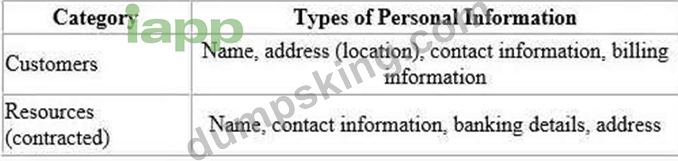
Clean-Q has an internal employee base of about 30 people. A recent privacy compliance exercise has been conducted to align employee data management and human resource functions with applicable data protection regulation. Therefore, the Clean-Q permanent employee base is not included as part of this scenario.
With an increase in construction work and housing developments, Clean-Q has had an influx of requests for cleaning services. The demand has overwhelmed Clean-Q's traditional supply and demand system that has caused some overlapping bookings.
Ina business strategy session held by senior management recently, Clear-Q invited vendors to present potential solutions to their current operational issues. These vendors included Application developers and Cloud-Q's solution providers, presenting their proposed solutions and platforms.
The Managing Director opted to initiate the process to integrate Clean-Q's operations with a cloud solution (LeadOps) that will provide the following solution one single online platform: A web interface that Clean-Q accesses for the purposes of resource and customer management. This would entail uploading resource and customer information.
* A customer facing web interface that enables customers to register, manage and submit cleaning service requests online.
* A resource facing web interface that enables resources to apply and manage their assigned jobs.
* An online payment facility for customers to pay for services.
Considering that LeadOps will host/process personal information on behalf of Clean-Q remotely, what is an appropriate next step for Clean-Q senior management to assess LeadOps' appropriateness?
- A. Obtain a legal opinion from an external law firm on contracts management.
- B. Determine if any Clean-Q competitors currently use LeadOps as a solution.
- C. Nothing at this stage as the Managing Director has made a decision.
- D. Involve the Information Security team to understand in more detail the types of services and solutions LeadOps is proposing.
Answer: D
Explanation:
Explanation/Reference:
NEW QUESTION # 108
Which of the following is considered a records management best practice?
- A. Storing decryption keys with their associated backup systems.
- B. Using classification to determine access rules and retention policy.
- C. Archiving expired data records and files.
- D. Implementing consistent handling practices across all record types.
Answer: B
Explanation:
Records management best practices include classifying data to determine appropriate access controls and retention policies. Classification allows organizations to systematically identify and manage records according to their level of sensitivity and importance, ensuring that data is accessible only to authorized personnel and retained for the required duration. This practice helps in maintaining data security and compliance with legal and regulatory requirements. The IAPP documentation emphasizes the importance of data classification in establishing robust data governance frameworks (IAPP, "Records Management and Data Classification").
NEW QUESTION # 109
SCENARIO
Please use the following to answer the next question:
Chuck, a compliance auditor for a consulting firm focusing on healthcare clients, was required to travel to the client's office to perform an onsite review of the client's operations. He rented a car from Finley Motors upon arrival at the airport as so he could commute to and from the client's office. The car rental agreement was electronically signed by Chuck and included his name, address, driver's license, make/model of the car, billing rate, and additional details describing the rental transaction. On the second night, Chuck was caught by a red light camera not stopping at an intersection on his way to dinner. Chuck returned the car back to the car rental agency at the end week without mentioning the infraction and Finley Motors emailed a copy of the final receipt to the address on file.
Local law enforcement later reviewed the red light camera footage. As Finley Motors is the registered owner of the car, a notice was sent to them indicating the infraction and fine incurred. This notice included the license plate number, occurrence date and time, a photograph of the driver, and a web portal link to a video clip of the violation for further review. Finley Motors, however, was not responsible for the violation as they were not driving the car at the time and transferred the incident to AMP Payment Resources for further review. AMP Payment Resources identified Chuck as the driver based on the rental agreement he signed when picking up the car and then contacted Chuck directly through a written letter regarding the infraction to collect the fine.
After reviewing the incident through the AMP Payment Resources' web portal, Chuck paid the fine using his personal credit card. Two weeks later, Finley Motors sent Chuck an email promotion offering 10% off a future rental.
What is the most secure method Finley Motors should use to transmit Chuck's information to AMP Payment Resources?
- A. HyperText Transfer Protocol (HTTP).
- B. Certificate Authority (CA).
- C. Cloud file transfer services.
- D. Transport Layer Security (TLS).
Answer: D
Explanation:
TLS is a cryptographic protocol that provides secure communication over a network. It can help protect against eavesdropping and tampering by encrypting data in transit. Cloud file transfer services (option A) can also provide secure transmission of data but their security depends on the specific service used. Certificate Authority (CA) (option B) is not a method for transmitting data but rather a trusted third party that issues digital certificates used for authentication. HyperText Transfer Protocol (HTTP) (option C) is not a secure method for transmitting sensitive data as it does not provide encryption.
NEW QUESTION # 110
In the realm of artificial intelligence, how has deep learning enabled greater implementation of machine learning?
- A. By hand coding software routines with a specific set of instructions to accomplish a task.
- B. By increasing the size of neural networks and running massive amounts of data through the network to train it.
- C. By using hand-coded classifiers like edge detection filters so that a program can identify where an object starts and stops.
- D. By using algorithmic approaches such as decision tree learning and inductive logic programming.
Answer: B
Explanation:
Deep learning, a subset of machine learning, has enabled the greater implementation of machine learning by significantly enhancing the capabilities of neural networks. Here's how:
* Neural Networks Expansion: Deep learning involves the use of large, complex neural networks that have many layers (hence the term "deep"). These networks can model intricate patterns and representations in data.
* Massive Data Processing: Deep learning algorithms require and utilize vast amounts of data to train these neural networks. The more data processed, the better the model can learn to generalize and perform accurately on new data.
* Automatic Feature Extraction: Unlike traditional machine learning methods that often require manual feature extraction, deep learning algorithms can automatically learn and extract features from raw data.
This eliminates the need for hand-coded classifiers and simplifies the process of implementing machine learning models.
* Performance Improvements: The ability to process and learn from large datasets has led to breakthroughs in various fields such as image and speech recognition, natural language processing, and autonomous driving.
NEW QUESTION # 111
Which is NOT a drawback to using a biometric recognition system?
- A. It can require more maintenance and support.
- B. It is difficult for people to use.
- C. It has limited compatibility across systems.
- D. It can be more expensive than other systems
Answer: B
Explanation:
Biometric recognition systems can face several challenges, but user difficulty is not generally considered a significant drawback. The main drawbacks typically include higher costs, increased maintenance and support requirements, and limited compatibility across different systems. Biometrics can sometimes also raise privacy concerns and require substantial infrastructure to support effectively. However, ease of use is often seen as a benefit of biometric systems since they can be more intuitive than traditional passwords or PINs.
NEW QUESTION # 112
An organization based in California, USA is implementing a new online helpdesk solution for recording customer call information. The organization considers the capture of personal data on the online helpdesk solution to be in the interest of the company in best servicing customer calls.
Before implementation, a privacy technologist should conduct which of the following?
- A. A security assessment of the help desk solution and provider to assess if the technology was developed with a security by design approach.
- B. A Data Protection Impact Assessment (DPIA) and consultation with the appropriate regulator to ensure legal compliance.
- C. A Legitimate Interest Assessment (LIA) to ensure that the processing is proportionate and does not override the privacy, rights and freedoms of the customers.
- D. A privacy risk and impact assessment to evaluate potential risks from the proposed processing operations.
Answer: C
Explanation:
In the context of an organization based in California, USA, considering the capture of personal data for best servicing customer calls, the most appropriate step before implementing the online helpdesk solution is to conduct a Legitimate Interest Assessment (LIA). This assessment ensures that the processing of personal data is necessary for the organization's legitimate interests and that it does not infringe upon the privacy, rights, and freedoms of individuals. An LIA helps to balance the company's interests with the privacy rights of the customers and includes an evaluation of necessity, proportionality, and safeguards. This aligns with privacy regulations and best practices as outlined in the IAPP's Information Privacy Technologist guidelines.
NEW QUESTION # 113
What is the main privacy threat posed by Radio Frequency Identification (RFID)?
- A. An individual can scramble computer transmissions in weapons systems.
- B. An individual can use an RFID receiver to engage in video surveillance.
- C. An individual can tap mobile phone communications.
- D. An individual with an RFID receiver can track people or consumer products.
Answer: C
NEW QUESTION # 114
SCENARIO
Looking back at your first two years as the Director of Personal Information Protection and Compliance for the Berry Country Regional Medical Center in Thorn Bay, Ontario, Canada, you see a parade of accomplishments, from developing state-of-the-art simulation based training for employees on privacy protection to establishing an interactive medical records system that is accessible by patients as well as by the medical personnel. Now, however, a question you have put off looms large: how do we manage all the data-not only records produced recently, but those still on hand from years ago? A data flow diagram generated last year shows multiple servers, databases, and work stations, many of which hold files that have not yet been incorporated into the new records system. While most of this data is encrypted, its persistence may pose security and compliance concerns. The situation is further complicated by several long-term studies being conducted by the medical staff using patient information. Having recently reviewed the major Canadian privacy regulations, you want to make certain that the medical center is observing them.
You also recall a recent visit to the Records Storage Section, often termed "The Dungeon" in the basement of the old hospital next to the modern facility, where you noticed a multitude of paper records. Some of these were in crates marked by years, medical condition or alphabetically by patient name, while others were in undifferentiated bundles on shelves and on the floor. The back shelves of the section housed data tapes and old hard drives that were often unlabeled but appeared to be years old. On your way out of the dungeon, you noticed just ahead of you a small man in a lab coat who you did not recognize. He carried a batch of folders under his arm, apparently records he had removed from storage.
Which cryptographic standard would be most appropriate for protecting patient credit card information in the records system?
- A. Asymmetric Encryption
- B. Symmetric Encryption
- C. Hashing
- D. Obfuscation
Answer: B
Explanation:
For protecting patient credit card information in the records system, symmetric encryption is the most appropriate cryptographic standard. Here's why:
* Efficiency: Symmetric encryption algorithms are typically faster and require less computational power than asymmetric algorithms, making them suitable for encrypting large amounts of data, such as patient credit card information.
* Security: Symmetric encryption, when using strong algorithms (like AES - Advanced Encryption Standard), provides a high level of security. It ensures that data remains confidential as long as the encryption key is securely managed.
* Use Case: Credit card information typically needs to be encrypted and decrypted frequently and quickly, which is a strength of symmetric encryption.
While asymmetric encryption is used for secure key exchange and digital signatures, it is less efficient for encrypting large data sets. Hashing and obfuscation do not provide the required reversible encryption suitable for protecting credit card data. References: IAPP Certification Textbooks, Section on Cryptographic Standards and Data Protection Techniques.
NEW QUESTION # 115
A valid argument against data minimization is that it?
- A. Can limit business opportunities.
- B. Decreases the speed of data transfers.
- C. Increases the chance that someone can be identified from data.
- D. Can have an adverse effect on data quality.
Answer: A
NEW QUESTION # 116
Many modern vehicles incorporate technologies that increase the convenience of drivers, but collect information about driver behavior in order to Implement this. What should vehicle manufacturers prioritize to ensure enhanced privacy protection for drivers?
- A. Provide easy to read, in-vehicle instructions about how to use the technology.
- B. Derive implicit consent for the processing of sensitive data by the continued use of the vehicle.
- C. Obtain affirmative consent for processing of sensitive data about the driver.
- D. Share the sensitive data collected about driver behavior with the driver.
Answer: C
Explanation:
Vehicle manufacturers should prioritize obtaining affirmative consent for processing sensitive data about the driver to ensure enhanced privacy protection. Affirmative consent, often referred to as explicit consent, involves a clear and unambiguous action by the user agreeing to the processing of their personal data. This is particularly important for sensitive data, which includes information about driver behavior, as it requires a higher level of protection and user awareness. (Reference: IAPP CIPT Study Guide, Chapter on Consent and User Rights)
NEW QUESTION # 117
......
Pass CIPT Exam - Real Questions and Answers: https://dumpstorrent.dumpsking.com/CIPT-testking-dumps.html
