

CRT-450 Dumps for Pass Guaranteed - Pass CRT-450 Exam 2026
CRT-450 Exam Dumps - Try Best CRT-450 Exam Questions from Training Expert DumpsKing
NEW QUESTION # 144
Universal Container wants Opportunities to no longer be editable when itreaches the Closed/Won stage.
Which two strategies can a developer use to accomplish this?
Choose2 answer
- A. Use an after-save flow.
- B. Use a validation
- C. Use a trigger
- D. Use the Process Automation settings.
Answer: B,C
Explanation:
A developer can use a validation rule or a trigger to prevent Opportunities from being edited when they reach the Closed/Won stage. A validation rule can check the stage value and display an error message if the user tries to modify the record. A trigger can also check the stage value and throw an exception if the user tries to update the record. Both of these strategies can enforce the business logic at the database level and prevent unwanted changes.
An after-save flow or the Process Automation settings are not suitable for this requirement, because they are executed after the record is saved to the database. They can perform actions based on the record changes, but they cannot prevent the record from being edited in the first place.
References:
* 1: Validation Rules (Salesforce Help)
* 2: Triggers (Apex Developer Guide)
* 3: Run Flows After a Record Is Saved (Lightning Flow Developer Guide)
* 4: Process Automation Settings (Salesforce Help)
NEW QUESTION # 145
A developer writes a trigger on the Account object on the before update event that increments a count field. A workflow rule also increments the count field every time that an Account is created or update. The field update in the workflow rule is configured to not re-evaluate workflow rules. What is the value of the count field if an Account is inserted with an initial value of zero, assuming no other automation logic is implemented on the Account?
- A. 0
- B. 1
- C. 2
- D. 3
Answer: B
NEW QUESTION # 146
An Apex method, getAccounts, that returns a List of Accounts given a searchTerm, is available for Lightning Web Components to use.
What is the correct definition of a Lightning Web Component property that uses the getAccounts method?
- A. @wire(getAccounts, '$searchTerm')
- B. @track(getAccounts, '$searchTerm')
- C. @wire(getAccounts, { searchTerm: '$searchTerm' })
- D. @wire(getAccounts, 'searchTerm: $searchTerm')
Answer: C
Explanation:
The correct syntax for using @wire to connect a Lightning Web Component property to an Apex method requires specifying the method and a configuration object that includes the reactive property prefixed with $.
The correct usage is:
javascript
CopyEdit
@wire(getAccounts, { searchTerm: '$searchTerm' })
This correctly wires the reactive searchTerm property to the getAccounts method.
Reference:
Wire a Property to an Apex Method
To determine the correct definition of a Lightning Web Component (LWC) property that uses the getAccounts Apex method, we need to evaluate the syntax and usage of the @wire decorator in LWC, focusing on how it connects to Apex methods and passes parameters. Let's analyze the problem and each option systematically, referencing Salesforce's official Lightning Web Components Developer Guide.
Understanding the Requirement:
Apex Method: The getAccounts method is an Apex method that returns a List<Account> and takes a parameter searchTerm. For an Apex method to be callable from an LWC, it must be annotated with
@AuraEnabled(cacheable=true) (for @wire) and be static. The Lightning Web Components Developer Guide states: "To call an Apex method from a Lightning Web Component using @wire, the method must be static and annotated with @AuraEnabled(cacheable=true)" (Salesforce Lightning Web Components Developer Guide, Call Apex Methods).
LWC Property: The question asks for the correct definition of an LWC property that uses @wire to call getAccounts. The @wire decorator is used to wire a property or function to a data source, such as an Apex method, and can pass dynamic parameters.
Parameter Passing: The searchTerm parameter must be passed dynamically to getAccounts, meaning its value comes from a reactive property (e.g., searchTerm) in the LWC. In LWC, reactive properties are tracked for changes, and the $ prefix is used to indicate reactivity in @wire parameters.
LWC @wire Syntax:
The @wire decorator connects a property or function to a data source (e.g., an Apex method). When wiring to an Apex method, the syntax is:
javascript
Copy
@wire(apexMethod, { param1: '$property1', param2: '$property2' })
propertyName;
Apex Method Reference: The apexMethod is the imported Apex method (e.g., getAccounts imported from a controller).
Parameters: The second argument is an object mapping Apex method parameters to LWC properties. The $ prefix makes the property reactive, meaning the wired method re-invokes when the property changes. The Lightning Web Components Developer Guide explains: "Use the $ prefix in the parameters object to indicate a reactive property, so the wired method is called when the property's value changes" (Salesforce Lightning Web Components Developer Guide, Pass Parameters to Apex Methods).
Result: The wired property receives an object with data (the Apex method's return value) or error (if an error occurs).
Evaluating the Options:
A). @wire(getAccounts, { searchTerm: '$searchTerm' })
Syntax: Uses @wire to call getAccounts and passes parameters as an object { searchTerm: '$searchTerm' }.
Parameter Mapping: The searchTerm parameter of the getAccounts Apex method is mapped to the LWC's searchTerm property. The $searchTerm syntax indicates that searchTerm is a reactive property, and getAccounts will be re-invoked if searchTerm changes.
Correctness: This matches the standard LWC syntax for wiring an Apex method with parameters. The Lightning Web Components Developer Guide confirms: "Pass parameters to an Apex method as a JavaScript object, using the $ prefix for reactive properties" (Salesforce Lightning Web Components Developer Guide, Call Apex Methods).
Conclusion: Correct, as it uses the proper @wire syntax and parameter format.
B). @track(getAccounts, '$searchTerm')
Syntax: Uses @track instead of @wire.
Decorator: The @track decorator is used to make a property reactive, meaning the component re-renders when the property changes, but it does not wire the property to a data source like an Apex method. The Lightning Web Components Developer Guide states: "@track is used to mark a property as reactive for re- rendering, but it does not fetch data from a server" (Salesforce Lightning Web Components Developer Guide, Reactive Properties).
Parameter: Passing getAccounts and '$searchTerm' to @track is invalid, as @track does not accept arguments in this manner.
Conclusion: Incorrect, as @track cannot be used to wire an Apex method.
C). @wire(getAccounts, 'searchTerm: $searchTerm')
Syntax: Uses @wire to call getAccounts, but the parameters are passed as a string 'searchTerm: $searchTerm'.
Parameter Format: The @wire decorator expects the second argument to be a JavaScript object (e.g., { searchTerm: '$searchTerm' }), not a string. The Lightning Web Components Developer Guide specifies: "The second argument to @wire for an Apex method must be an object mapping parameter names to values" (Salesforce Lightning Web Components Developer Guide, Pass Parameters to Apex Methods). Passing a string like 'searchTerm: $searchTerm' results in a runtime error or the Apex method not being called correctly.
Conclusion: Incorrect, as the parameter format is invalid (string instead of an object).
D). @wire(getAccounts, '$searchTerm')
Syntax: Uses @wire to call getAccounts, but passes '$searchTerm' directly as a string, not as a parameter object.
Parameter Format: The getAccounts method expects a parameter named searchTerm, so the correct format is { searchTerm: '$searchTerm' }. Passing '$searchTerm' as a single value does not map to the Apex method's parameter name, causing the method to receive no value for searchTerm (or fail entirely). The Lightning Web Components Developer Guide notes: "Parameter names in the object must match the Apex method's parameter names" (Salesforce Lightning Web Components Developer Guide, Call Apex Methods).
Conclusion: Incorrect, as the parameter is not passed as a properly formatted object mapping to the Apex method's parameter.
Why Option A is Correct:
Option A is correct because:
It uses the @wire decorator to properly connect the getAccounts Apex method to an LWC property.
It passes the searchTerm parameter in the correct format: { searchTerm: '$searchTerm' }, mapping the Apex method's parameter to the LWC's reactive searchTerm property.
The $searchTerm syntax ensures reactivity, so the getAccounts method is re-invoked when searchTerm changes, aligning with LWC best practices.
This matches the standard syntax outlined in the Salesforce Lightning Web Components Developer Guide for wiring Apex methods with parameters.
Example for Clarity:
Here's how option A would be used in a complete LWC JavaScript file:
javascript
Copy
import { LightningElement, wire } from 'lwc';
import getAccounts from '@salesforce/apex/AccountController.getAccounts'; export default class MyComponent extends LightningElement { searchTerm = ''; // Reactive property for search term
// Wire the getAccounts Apex method to a property
@wire(getAccounts, { searchTerm: '$searchTerm' })
accounts;
// Example: Update searchTerm based on user input
handleSearchTermChange(event) {
this.searchTerm = event.target.value;
}
}
Apex Controller (for reference):
apex
Copy
public with sharing class AccountController {
@AuraEnabled(cacheable=true)
public static List<Account> getAccounts(String searchTerm) {
return [SELECT Id, Name FROM Account WHERE Name LIKE :('%' + searchTerm + '%')];
}
}
Behavior: When searchTerm changes (e.g., due to user input), the @wire decorator re-invokes getAccounts with the new searchTerm value, and the accounts property receives the result (e.g., { data: [/* Account records */], error: undefined }).
Handling Typos:
The options are syntactically correct in the provided image, with no typos to address. However, the options assume getAccounts is properly imported and defined in the Apex controller, which we infer based on the question's context.
The question's phrasing is clear, and the options align with typical LWC syntax patterns.
References:
Salesforce Lightning Web Components Developer Guide:
"Call Apex Methods" section: Details the use of @wire to call Apex methods, including parameter passing.
"Pass Parameters to Apex Methods" section: Explains the { param: '$property' } syntax for reactive parameters.
"Reactive Properties" section: Clarifies the role of @track (and why it's not applicable here).(Available at:
https://developer.salesforce.com/docs/component-library/documentation/en/lwc/) Salesforce Apex Developer Guide:
"AuraEnabled Annotation" section: Describes requirements for Apex methods to be callable from LWC (@AuraEnabled(cacheable=true)).(Available at: https://developer.salesforce.com/docs/atlas.en-us.apexcode.
meta/apexcode/)
Platform Developer I Study Guide:
Section on "User Interface": Covers building LWCs, including wiring Apex methods and handling reactivity.
(Available at: https://trailhead.salesforce.com/en/content/learn/modules/platform-developer-i-certification- study-guide)
NEW QUESTION # 147
A developer has the controller class below.
Which code block will run successfully in an execute anonymous window?
- A. myFooController m = new myFooController();System.assert(m.prop ==1);
- B. myFooController m = new myFooController();System.assert(m.prop ==null);
- C. myFooController m = new myFooController();System.assert(m.prop ==0);
- D. myFooController m = new myFooController();System.assert(m.prop !=null);
Answer: B
NEW QUESTION # 148
A developer needs to create an audit trail for records that are sent to the recycle bin.
Which type of trigger is most appropriate to create?
- A. before delete
- B. before undelete
- C. after delete
- D. after undelete
Answer: C
NEW QUESTION # 149
A developer needs to test an Invoicing system integration. After reviewing the number of transactions required for the test, the developer estimates that the test data will total about 2 GB of data storage. Production data is not required for the integration testing.
Which two environments meet the requirements for testing? (Choose two.)
- A. Partial Sandbox
- B. Developer Sandbox
- C. Full Sandbox
- D. Developer Edition
- E. Developer Pro Sandbox
Answer: A,C
NEW QUESTION # 150
A Visual Flow uses an apex Action to provide additional information about multiple Contacts, stored in a custom class, contactInfo. Which is the correct definition of the Apex method that gets additional information?
- A. @invocableMethod(label)='Additional Info')
public static List<ContactInfo> getInfo(List<Id> contactIds)
{ /*Implementation*/ } - B. @InvocableMethod(label='Additional Info')
public List<ContactInfo> getInfo(List<Id> contactIds)
{ /*implementation*/ } - C. @InvocableMethod(Label='additional Info')
public ContactInfo(Id contactId)
{ /*implementation*/ } - D. @InvocableMethod(label='additional Info')
public static ContactInfo getInfo(Id contactId)
{ /*implementation*/ }
Answer: A
NEW QUESTION # 151
Which code in a Visualforce page and/or controller might present a security vulnerability?
- A. <apex:outputField value="{!ctrl.userInput}" rendered="{!isEditable}" />
- B. <apex:outputText value="{!SCurrentPage.parameters.userInput}" />
- C. <apex:outputText escape="false" value="{!sCurrentPage.parameters.userInput}" />
- D. <apex:outputField value="{!ctrl.userInput}" />
Answer: C
Explanation:
Comprehensive and Detailed Explanation From Exact Extract:
To determine which Visualforce code snippet presents a security vulnerability, we need to evaluate each option for potential risks, such as cross-site scripting (XSS), based on Salesforce's Visualforce security best practices. XSS vulnerabilities occur when user input is rendered on a page without proper sanitization, allowing malicious scripts to execute. Let's analyze each option systematically, referencing Salesforce's official documentation, particularly the Visualforce Developer Guide and Secure Coding Guidelines.
Understanding Visualforce Security:
* Visualforce Components: Components like <apex:outputText> and <apex:outputField> are used to display data on a Visualforce page. Their behavior regarding HTML escaping (sanitizing output to prevent script injection) is critical to security.
* XSS Vulnerability: XSS occurs when untrusted user input (e.g., from URL parameters or controller variables) is rendered as HTML without escaping special characters (e.g., <, >, &). The Visualforce Developer Guide states: "To prevent XSS, Visualforce automatically escapes output unless explicitly disabled, but developers must be cautious with user input" (Salesforce Visualforce Developer Guide, Secure Coding for Visualforce).
* Key Security Features:
* <apex:outputText>: By default, escapes HTML characters unless escape="false" is set.
* <apex:outputField>: Automatically escapes output and is designed for bound fields, reducing XSS risk.
* User input (e.g., ApexPages.currentPage().getParameters()) must be sanitized to prevent injection of scripts like <script>alert('hack');</script>.
Evaluating the Options:
* A. <apex:outputText value="{!ApexPages.currentPage().getParameters().get('userInput')}" />
* Component: Uses <apex:outputText> to display a URL parameter (userInput) accessed via ApexPages.currentPage().getParameters().get('userInput').
* Escaping: The escape attribute is not specified, so <apex:outputText> defaults to escape="true".
The Visualforce Developer Guide confirms: "The apex:outputText component escapes HTML characters by default, converting characters like < to < to prevent script execution" (Salesforce Visualforce Developer Guide, apex:outputText).
* Security: Even though userInput is untrusted (coming from a URL parameter), the default escaping ensures that any malicious content (e.g., <script>alert('hack');</script>) is rendered as plain text (e.g., <script>alert('hack');</script>), preventing XSS.
* Conclusion: Safe, as default escaping mitigates XSS risks.
* Note on Typo: The question likely contains a typo in "SCurrentPage" (should be ApexPages.
currentPage()). For analysis, we assume the correct syntax, as the intent is clear.
* B. <apex:outputText escape="false" value="{!ApexPages.currentPage().getParameters().get(' userInput')}" />
* Component: Uses <apex:outputText> to display the userInput URL parameter.
* Escaping: Explicitly sets escape="false", disabling HTML escaping. The Visualforce Developer Guide warns: "Setting escape='false' on apex:outputText allows unescaped output, which can lead to XSS vulnerabilities if the data is not sanitized" (Salesforce Visualforce Developer Guide, Secure Coding for Visualforce).
* Security: With escape="false", any malicious input in userInput (e.g., <script>alert('hack');<
/script>) is rendered as executable HTML, enabling XSS. For example, a URL like ?
userInput=<script>alert('hack');</script> would execute the script in the user's browser. The Salesforce Secure Coding Guidelines explicitly state: "Avoid setting escape='false' on apex:
outputText when rendering untrusted input, such as URL parameters" (Salesforce Secure Coding Guidelines, Cross-Site Scripting).
* Conclusion: Presents a security vulnerability (XSS) due to disabled escaping with untrusted input.
* Note on Typo: The question has a typo in "sCurrentPage" (should be ApexPages.currentPage()).
We assume the correct syntax for analysis.
* C. <apex:outputField value="{!ctrl.userInput}" rendered="{!isEditable}" />
* Component: Uses <apex:outputField> to display a controller variable (ctrl.userInput), with a rendered attribute based on isEditable.
* Escaping: <apex:outputField> is designed to display field values from sObjects and automatically escapes output to prevent XSS. The Visualforce Developer Guide states: "The apex:
outputField component renders field data with automatic HTML escaping, ensuring safe output" (Salesforce Visualforce Developer Guide, apex:outputField). Even if ctrl.userInput contains malicious content, it's rendered as plain text.
* Security: The value attribute expects a field reference (e.g., {!object.FieldName}), but here it's bound to a controller variable (ctrl.userInput). This is unconventional, as <apex:outputField> is typically used for sObject fields. However, even if ctrl.userInput is untrusted, the automatic escaping prevents XSS. The rendered attribute (isEditable) controls visibility and does not affect escaping.
* Conclusion: Safe, as <apex:outputField> escapes output, though the usage is atypical.
* Note on Typo: The question has a typo in the value attribute: "(!ctrl.userinput)" should be {!ctrl.
userInput} (curly braces instead of parentheses), and "isfditable" should be isEditable. We assume the corrected syntax: <apex:outputField value="{!ctrl.userInput}" rendered="{!
isEditable}" />.
* D. <apex:outputField value="{!ctrl.userInput}" />
* Component: Uses <apex:outputField> to display a controller variable (ctrl.userInput).
* Escaping: As with option C, <apex:outputField> automatically escapes output, preventing XSS.
The Visualforce Developer Guide confirms: "apex:outputField ensures safe rendering by escaping special characters" (Salesforce Visualforce Developer Guide, apex:outputField).
* Security: Even if ctrl.userInput contains malicious content, it's rendered as plain text, mitigating XSS risks. Like option C, using <apex:outputField> for a controller variable is unusual, but it does not introduce a vulnerability.
* Conclusion: Safe, as <apex:outputField> escapes output.
* Note on Typo: The question has a typo in the value attribute: "{'ctrl.userInput}" should be {!ctrl.
userInput} (correct merge field syntax). We assume the corrected syntax: <apex:outputField value="{!ctrl.userInput}" />.
Why Option B is Correct:
Option B presents a security vulnerability because:
* It uses <apex:outputText> with escape="false", disabling HTML escaping.
* It renders untrusted user input (ApexPages.currentPage().getParameters().get('userInput')) directly, allowing malicious scripts to execute, which is a classic XSS vulnerability.
* The Salesforce Secure Coding Guidelines explicitly warn against this practice: "Rendering unescaped user input, such as URL parameters, can allow attackers to inject scripts" (Salesforce Secure Coding Guidelines, Cross-Site Scripting).
* The other options (A, C, D) either use default escaping (<apex:outputText> in A) or inherently safe components (<apex:outputField> in C and D), preventing XSS.
Handling Typos:
The question contains several typos, which were corrected for analysis:
* Option A: "SCurrentPage" # ApexPages.currentPage().
* Option B: "sCurrentPage" # ApexPages.currentPage().
* Option C: "(!ctrl.userinput)" # {!ctrl.userInput}, "isfditable" # isEditable.
* Option D: "{'ctrl.userInput}" # {!ctrl.userInput}.These corrections align with standard Visualforce and Apex syntax, ensuring the analysis reflects the intended functionality.
Example of the Vulnerability (Option B):
Consider a Visualforce page with option B's code:
<apex:page>
<apex:outputText escape="false" value="{!ApexPages.currentPage().getParameters().get('userInput')}" />
</apex:page>
If a user accesses the page with a URL like:
https://example.salesforce.com/apex/MyPage?userInput=<script>alert('Hacked!');</script> The script <script>alert('Hacked!');</script> is rendered as executable HTML, displaying an alert in the user's browser, demonstrating an XSS attack. In contrast, option A (with default escaping) would render the script as plain text, preventing execution.
Mitigating the Vulnerability:
To fix option B, either:
* Remove escape="false" to enable default escaping:
<apex:outputText value="{!ApexPages.currentPage().getParameters().get('userInput')}" />
* Sanitize the input in the controller using methods like String.escapeHtml4():
public String getUserInput() {
String input = ApexPages.currentPage().getParameters().get('userInput'); return input != null ? String.escapeHtml4(input) : '';
}
<apex:outputText value="{!userInput}" />
The Visualforce Developer Guide recommends: "Sanitize untrusted input or rely on Visualforce's built-in escaping to prevent XSS" (Salesforce Visualforce Developer Guide, Secure Coding for Visualforce).
References:
Salesforce Visualforce Developer Guide:
"apex:outputText" section: Details default escaping and the escape attribute's impact.
"apex:outputField" section: Confirms automatic escaping for field output.
"Secure Coding for Visualforce" section: Explains XSS prevention and best practices.(Available at:
https://developer.salesforce.com/docs/atlas.en-us.pages.meta/pages/)
Salesforce Secure Coding Guidelines:
"Cross-Site Scripting (XSS)" section: Warns against rendering unescaped user input and disabling escaping.
(Available at: https://developer.salesforce.com/docs/atlas.en-us.secure_coding_guide.meta
/secure_coding_guide/)
Salesforce Apex Developer Guide:
"ApexPages Class" section: Describes ApexPages.currentPage().getParameters() for accessing URL parameters.(Available at: https://developer.salesforce.com/docs/atlas.en-us.apexcode.meta/apexcode/) Platform Developer I Study Guide:
Section on "Salesforce Platform and Declarative Features": Emphasizes secure Visualforce development and XSS prevention.(Available at: https://trailhead.salesforce.com/en/content/learn/modules/platform-developer-i- certification-study-guide)
NEW QUESTION # 152
When a task is created for a contact, how can a developer prevent the task from being included on the activity timeline of the contact's account record?
- A. In activity settings,uncheck roll-up activities to a contact's primary account
- B. Use process builder to create a process to set the task account field to blank
- C. Create a task trigger to set the account field to NULL
- D. By default,tasks do not display on the account activity timeline
Answer: A
NEW QUESTION # 153
Which two approaches optimize test maintenance and support future declarative configuration changes? Choose 2 answers.
- A. Create a methods that loads valid Account records from a static resources, then call this method within test methods.
- B. Create a method that performs a callout for valid records, then call this method within test methods.
- C. Create a method that creates valid records,then call this method within test methods.
- D. Create a method that queries for valid records, then call this method within test methods.
Answer: A,C
NEW QUESTION # 154
A developer needs to implement a custom SOAP Web Service that is used by an external Web Application. The developer chooses to include helper methods that are not used by the Web Application in the implementation of the Web Service Class.
Which code segment shows the correct declaration of the class and methods?
- A.

- B.

- C.

- D.

Answer: B
NEW QUESTION # 155
A developer writes a trigger on the Account object on the before update event that increments a count field. A workflow rule also increments the count field every time that an Account is created or updated. The field update in the workflow rule is configured to not re-evaluate workflow rules.
What is the value of the count field if an Account is inserted with an initial value of zero, assuming no other automation logic is implemented on the Account?
- A. 0
- B. 1
- C. 2
- D. 3
Answer: B
Explanation:
The value of the count field after inserting an Account with an initial value of zero is 2, because both the trigger and the workflow rule will increment the count field by 1. The order of execution for this scenario is as follows:
* The Account record is inserted with a count value of 0.
* The system runs the before insert trigger, which increments the count value to 1.
* The system saves the record to the database, but does not commit yet.
* The system runs the after insert trigger, which does not affect the count value.
* The system executes the workflow rule, which increments the count value to 2.
* The system updates the record again with the new count value.
* The system commits the record to the database.
The field update in the workflow rule is configured to not re-evaluate workflow rules, which means that the workflow rule will not be triggered again by the second update. Therefore, the count value will remain 2.
References: Triggers and Order of Execution, Workflow Field Updates, Learn Salesforce Order of Execution
NEW QUESTION # 156
When a user edits the Postal Code on an Account, a custom Account text field named
''Timezone'' must be updated based on the values another custom object object called.
What is the optimal way to Implement this feature?
- A. Build an account assignment rule.
- B. Create an account approval process.
- C. Create a formula field.
- D. Build a flow with flow Builder.
Answer: D
NEW QUESTION # 157
What is the result of the following code snippet?
- A. 0 Accounts are inserted.
- B. 1 Account is inserted.
- C. 200 Accounts are inserted.
- D. 201 Accounts are inserted.
Answer: A
NEW QUESTION # 158
How would a developer determine if a CustomObject__c record has been manually shared with the current user in Apex?
- A. By querying the role hierarchy.
- B. By calling the isShared() method for the record.
- C. By querying CustomObject__Share.
- D. By calling the profile settings of the current user.
Answer: C
NEW QUESTION # 159
Given the following code snippet, that is part of a custom controller for a Visualforce page: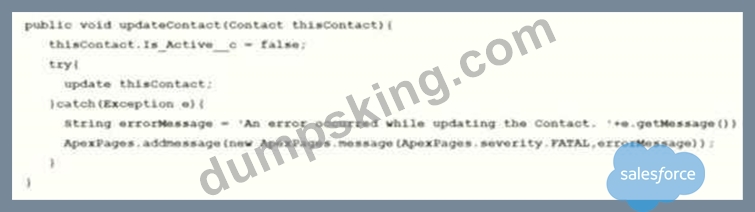
In which two ways can the try/catch be enclosed to enforce object and field-level permissions and prevent the DML statement from being executed if the current logged-in user does not have the appropriate level of access? Choose 2 answers
- A. Use if (thisContact.Owner = = UserInfo.getuserId ( ) )
- B. Use if (Schema , sobjectType. Contact. Field, Is_Active_c. is Updateable ( ) )
- C. Use if (Schema, sobjectType, Contact, isUpdatable ( ) )
- D. Use if (Schema.sObjectType.Contact.isAccessible ( ) )
Answer: B,C
NEW QUESTION # 160
From which 2 locations can a developer determine the overall code coverage for a sandbox?
- A. The tests tab of the developer console
- B. The apex classes setup page
- C. The test suite run panel of the developer console
- D. The apex test execution page
Answer: A,B
NEW QUESTION # 161
A developer created a Lightning web component called statusComponent to be inserted into the Account record page.
Which two things should the developer do to make this component available?
Choose 2 answers
- A.

- B.

- C.

- D.

Answer: B,C
NEW QUESTION # 162
......
Latest 100% Passing Guarantee - Brilliant CRT-450 Exam Questions PDF: https://dumpstorrent.dumpsking.com/CRT-450-testking-dumps.html
