

Accurate & Verified 2026 New MB-800 Answers As Experienced in the Actual Test!
MB-800 Certification Sample Questions certification Exam
The Microsoft MB-800 exam is an excellent opportunity if you’re a Functional Consultant who wants to skill up, rank up and earn more. In connection with the rapid development of Microsoft technology, most leading organizations demand that the skills and knowledge of their employees grow and improve as well. So, considering the fact that our world is a fast-paced one, the benefit of staying on top of new information in your field becomes more glaring. One sure way to scale up is to skill up or earn a certification known as Microsoft Certified: Dynamics 365 Business Central Functional Consultant Associate.
NEW QUESTION # 148
You are implementing Dynamics 365 Business Central.
The accounting manager for the company provides you with a chart of accounts.
You need to set up the general ledger accounts correctly.
Which setups should you use? To answer, drag the appropriate setups to the correct requirements. Each setup may be used once, more than once, or not at all. You may need to drag the split bar between panes or scroll to view content.
NOTE: Each correct selection is worth one point.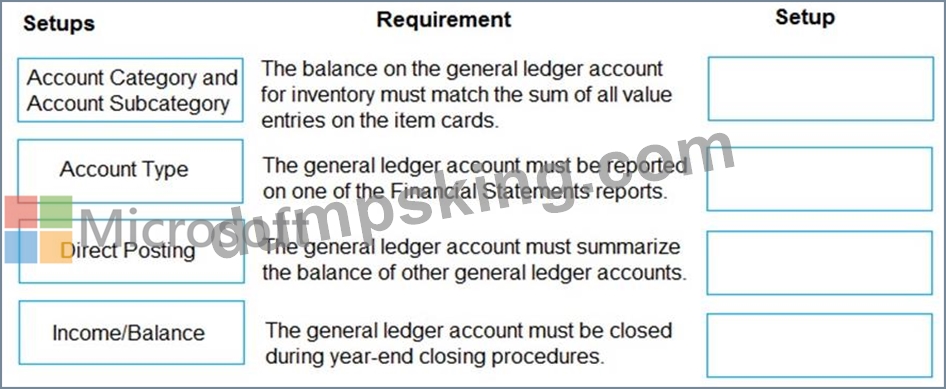
Answer:
Explanation: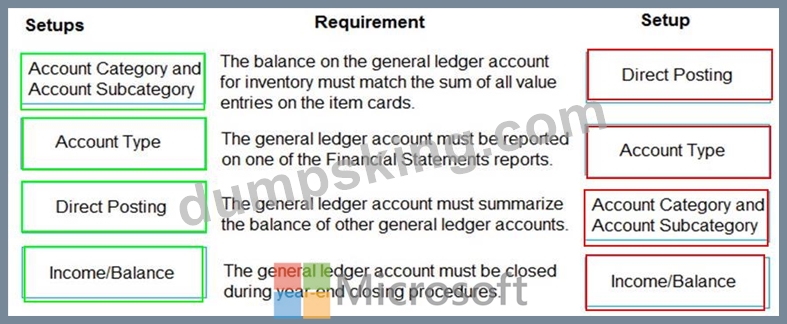
NEW QUESTION # 149
You create a new item in Microsoft Dynamics 365 Business Central.
You need to configure item settings.
Which item settings should you use? To answer, select the appropriate options in the answer area.
NOTE: Each correct selection is worth one point.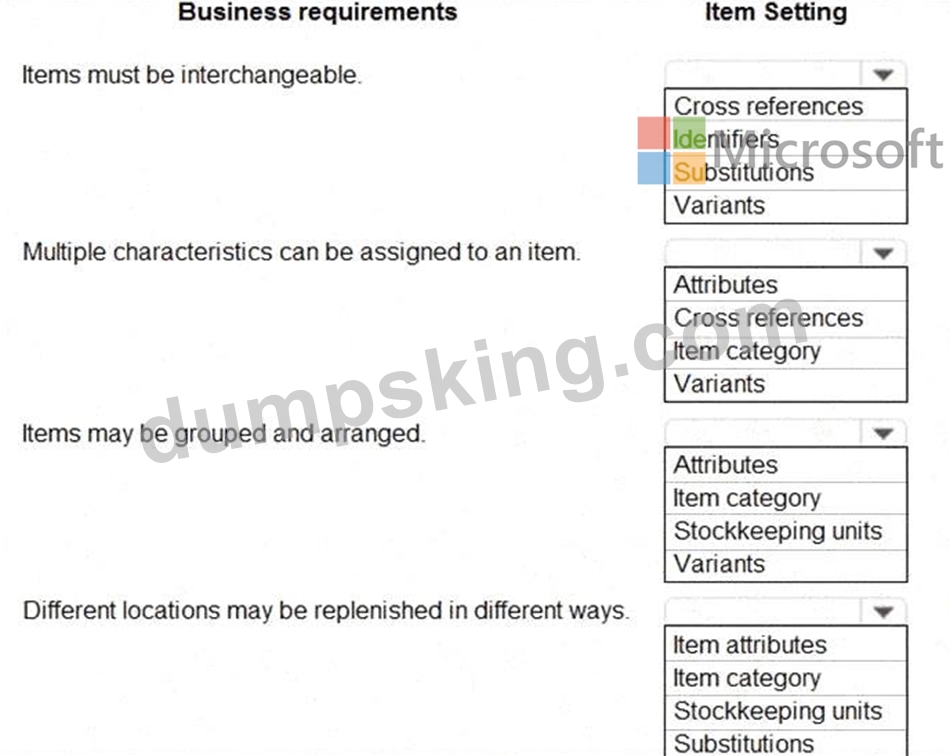
Answer:
Explanation: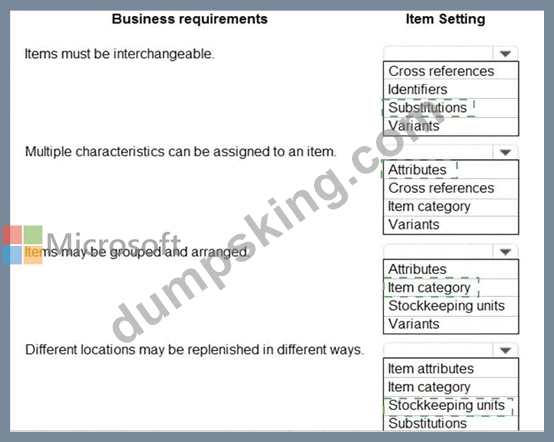
Explanation: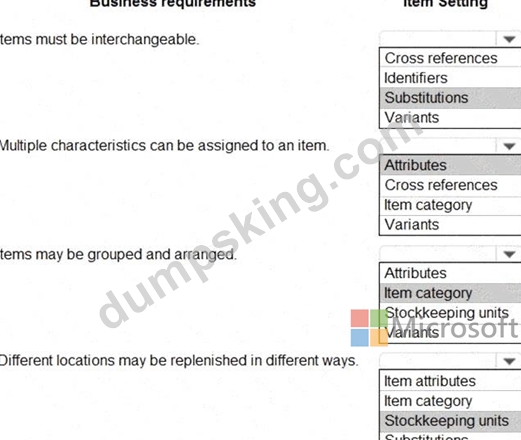
Comprehensive Detailed Explanation
Items must be interchangeable # Substitutions
In Business Central, if two or more items can be used in place of each other (e.g., a compatible part or product replacement), you configure them as Item Substitutions. This ensures users can select alternative items when the primary item is not available.
Reference: Microsoft Learn - Item Substitutions
Multiple characteristics can be assigned to an item # Attributes
Item Attributes (such as color, size, material, weight) are designed to assign multiple descriptive or searchable characteristics to an item. This enables filtering, reporting, and classification of products.
Reference: Microsoft Learn - Work with Item Attributes
Items may be grouped and arranged # Item category
Item Categories provide a structured way to group items (e.g., "Electronics," "Furniture") and manage reporting, posting groups, and default settings for items. This allows logical arrangement and categorization.
Reference: Microsoft Learn - Item Categories
Different locations may be replenished in different ways # Stockkeeping units Stockkeeping Units (SKUs) are used to set up location-specific item details, including replenishment method, safety stock, lead times, reorder policies, etc. For example, one warehouse might reorder an item via purchase, while another manufactures it.
Reference: Microsoft Learn - Create Stockkeeping Units
NEW QUESTION # 150
A company uses Business Central.
The company made a mistake on a posted sales invoice and must correct it.
You need to validate whether you can correct the posted sales invoice or need to create a new corrective credit memo.
Which validation action should you do?
- A. Shipment
- B. Prepayment
- C. Payment
Answer: A
NEW QUESTION # 151
A company uses Business Central.
The operations team posts an incorrect quantity received on a purchase order.
You need to undo the quantity posting on the posted purchase receipt before the purchase order is invoiced.
Which four actions should you perform in sequence? To answer, move the appropriate actions from the list of actions to the answer area and arrange them in the correct order.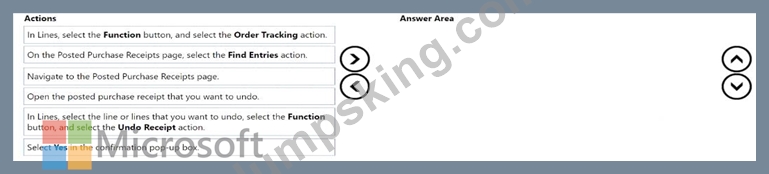
Answer:
Explanation: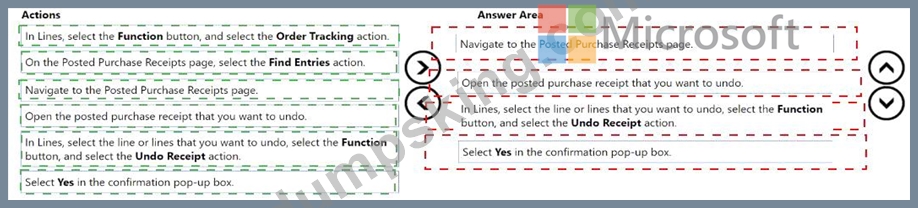
Explanation:
NEW QUESTION # 152
The company uses Dynamics 365 Business Central. You create several dimensions that will be used to perform cost analyses.
Some dimension value combinations are not allowed when posting purchase transactions.
You need to set up dimension combinations.
In which order should you perform the actions? To answer, move all the actions from the .list of actions and arrange them in the correct order.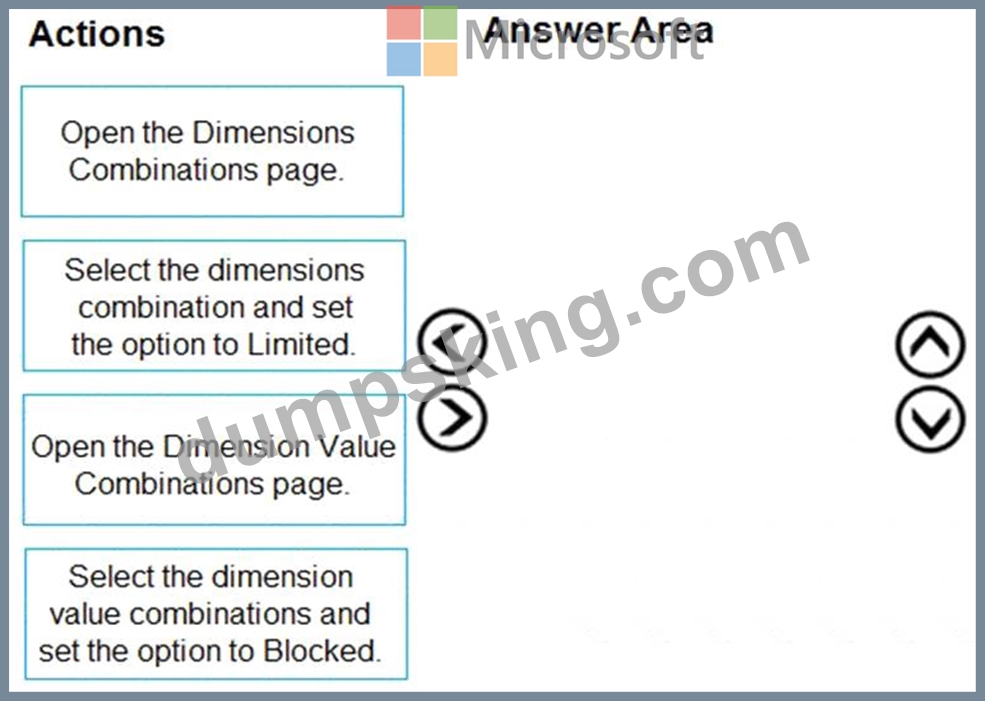
Answer:
Explanation: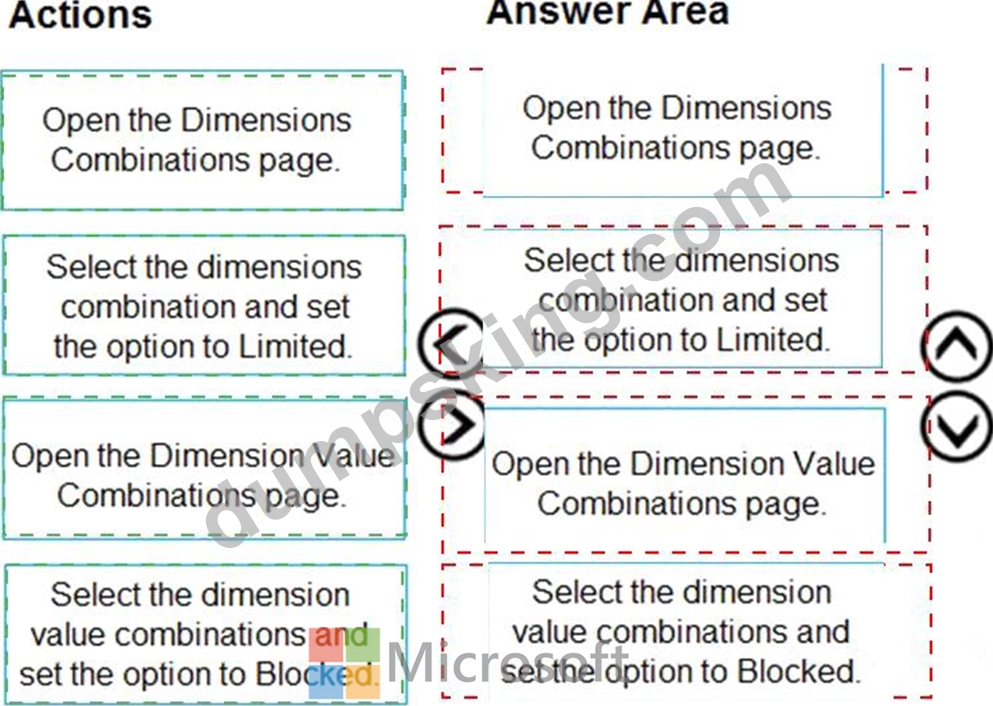
Explanation: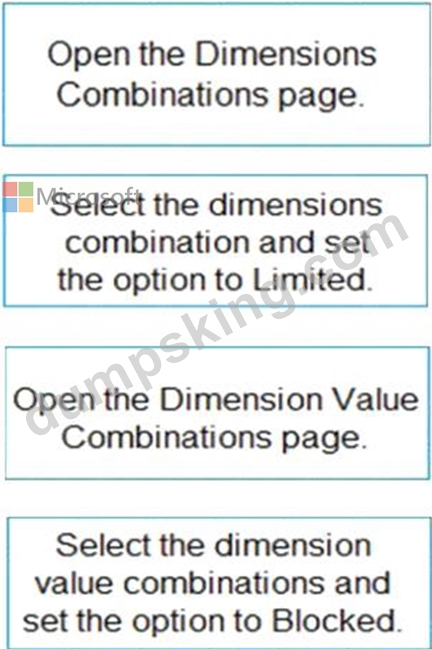
Reference:
https://docs.microsoft.com/en-gb/dynamics365/business-central/finance-dimensions
NEW QUESTION # 153
You are setting up and testing a workflow with approval hierarchy in Dynamics 365 Business Central.
In Approval User Setup, you configure the following users:
You create and enable an approval workflow. You configure the workflow to use the approver limit type Approver Chain.
To test the workflow, User1 creates a purchase order for $1,100 and runs the Send Approval Request function.
You need to identify the actions that occur when the workflow runs.
Which set of actions occurs?
- A. User4 will receive an approval request.
Once approved, the purchase order is released. - B. User3 receives an approval request.
Once User3 approves the request, the purchase order is released. - C. User3 will receive an approval request.
Once User3 approves the request, the request is routed to User4 for approval.
Once User4 approves the request, the purchase order is released. - D. User2 will receive an approval request.
Once User2 approves the request, User3 will receive an approval request.
Once User2 and User3 approve the request, the purchase order is released. - E. User1 will receive an approval request.
Once User1 approves the request, User2 must approve the request.
Once User2 approves the request, User3 must approve the request.
Once User3 approves the request, the purchase order is released.
Answer: C
Explanation:
Reference:
https://docs.microsoft.com/en-gb/dynamics365/business-central/across-how-to-set-up-approval-users
https://dynamics.tensoft.com/approval-user-setup-in-microsoft-dynamics-365-business-central/
NEW QUESTION # 154
You need to ensure that any transaction that uses a customer account always includes the customer source dimension.
Which five actions should you perform in sequence? To answer, move the appropriate actions from the list of actions to the answer area and arrange them in the correct order.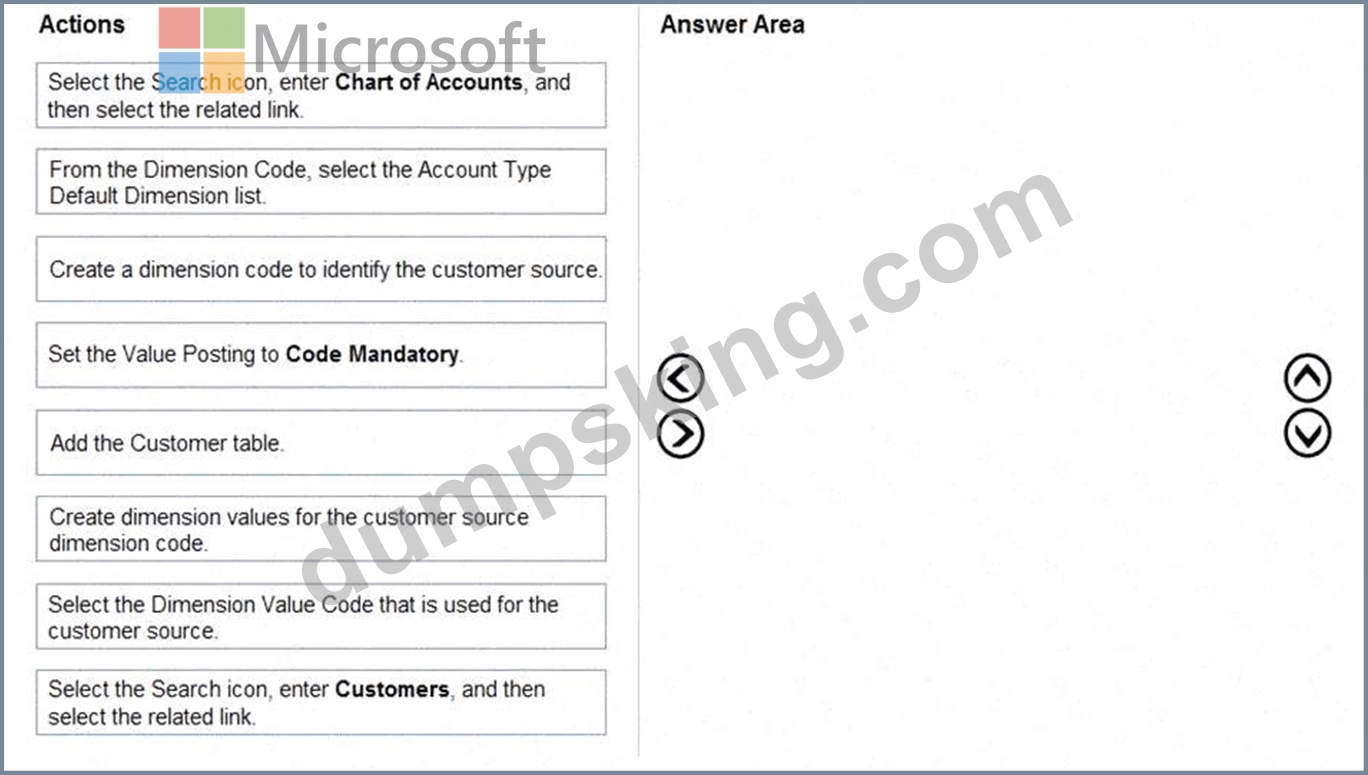
Answer:
Explanation: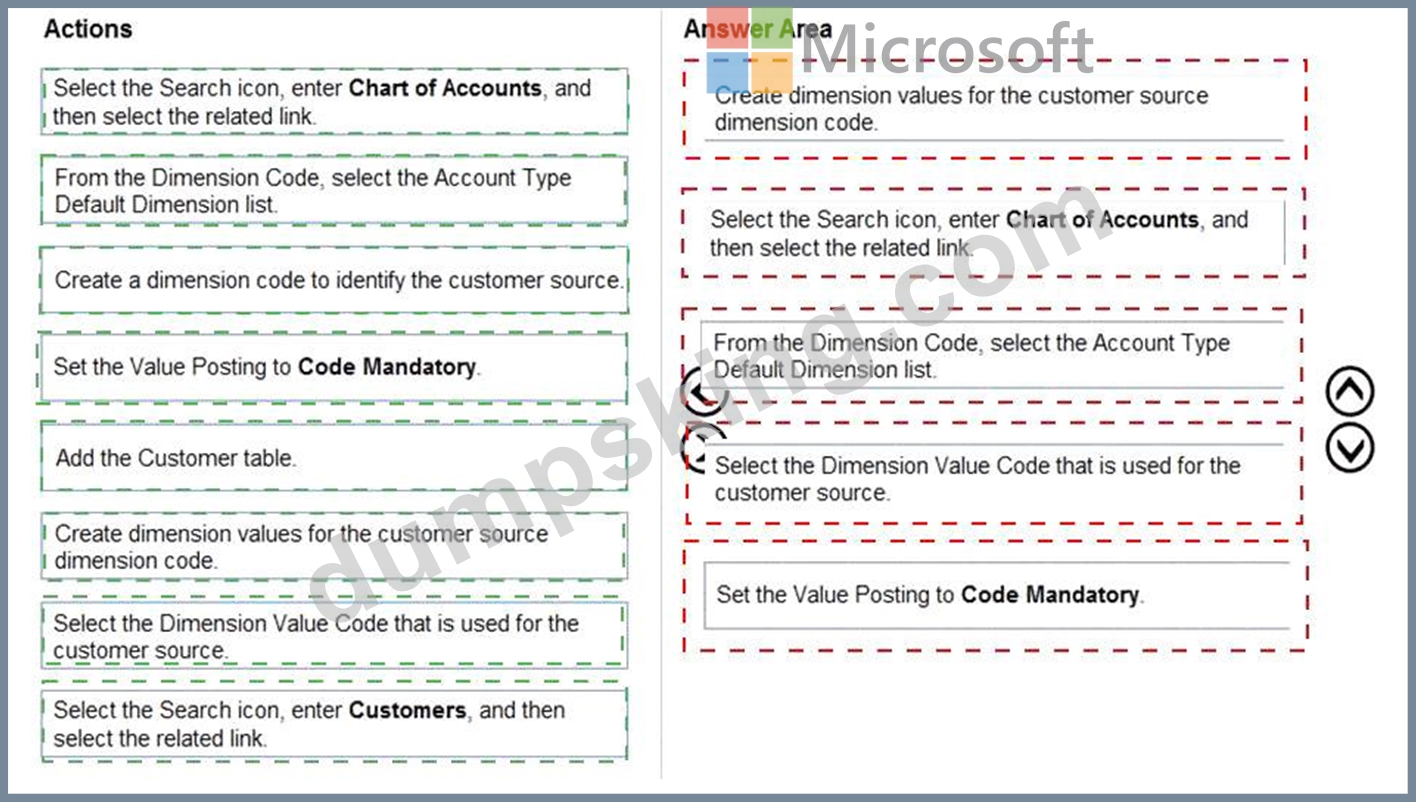
Explanation: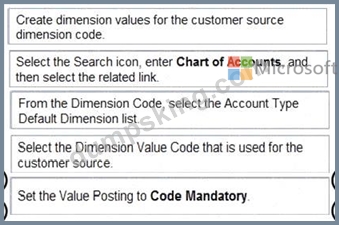
Comprehensive Detailed Explanation
The requirement is to ensure that every transaction posted to a customer account includes the Customer Source dimension (e.g., Cash & Carry, Brokered). This is achieved by creating and enforcing a mandatory dimension rule in Business Central.
Step 1: Create a dimension code to identify the customer source
First, define a Dimension Code such as Customer Source.
This will hold values like Cash & Carry and Brokered.
Dimensions are the foundation for all reporting segmentation in Business Central.
Step 2: Create dimension values for the customer source dimension code
After creating the dimension, define the specific Dimension Values (e.g., Cash & Carry, Brokered).
These represent the business lines the company wants to track.
Step 3: Add the Customer table
To enforce the dimension on customers, link the dimension to the Customer table.
This ensures that every transaction involving a customer account requires this dimension.
Step 4: Set the Value Posting to Code Mandatory
On the Default Dimensions page, set Value Posting = Code Mandatory for the Customer Source dimension.
This forces users (or the system) to provide a dimension value on every transaction involving customers.
Without this, users might skip dimension assignment, leading to incomplete reporting.
Step 5: Select the Dimension Value Code that is used for the customer source Finally, assign the correct Dimension Value (Cash & Carry or Brokered) to each customer record.
This ensures automatic defaulting during transaction entry, reducing user errors and maintaining consistency.
Why not the other actions?
Chart of Accounts: Not needed here, since the requirement applies to customers, not G/L accounts.
Account Type Default Dimension: Useful for G/L accounts, but here we are applying it at the Customer table level.
Search icon, Customers: While this helps you navigate, it's not a required setup step in the sequence.
Microsoft References
Work with Dimensions in Business Central
Set Up Default Dimensions for Customers
Dimension Value Posting Options
NEW QUESTION # 155
A company uses Dynamics 365 Business Central to manage receivables.
You must import a series of payments from a bank account and automatically match the payments against similar ledger entries already entered in Business Central.
You need to import and apply the payments to the ledger entries that are automatically matched by the system.
Which form should you use?
- A. Payment Registration
- B. Payment Reconciliation Journal
- C. Payment services
- D. Payment Application Rules
Answer: B
Explanation:
The requirement is to:
* Import a series of payments from a bank account (file from bank, e.g., CAMT.053, MT940, BAI2, or CSV).
* Automatically match the imported payments against customer/vendor ledger entries already in Business Central.
* Apply those matched entries automatically, while allowing review and manual matching for exceptions.
This is exactly what the Payment Reconciliation Journal is designed for:
* The Payment Reconciliation Journal page lets you import bank statement files or manually enter bank transactions.
* The system then attempts to auto-apply payments to open customer/vendor ledger entries using match rules (based on amount, document number, or text).
* Any unmatched payments can be handled manually or left open for investigation.
* Once complete, posting the journal reconciles the bank account and applies the payments.
Why not the other options?
* A. Payment Application Rules - These define how automatic application should work (match tolerance, priorities), but they are not the form to process the payments themselves.
* B. Payment Services - Used for online payment processing (e.g., PayPal, WorldPay), not for bank file imports.
* D. Payment Registration - A manual process to register payments (e.g., marking invoices as paid when receiving cash or checks at the counter). It does not support bank file imports or auto-matching.
Thus, the correct form is Payment Reconciliation Journal.
Microsoft Learn References
* Apply Customer Payments Using Payment Reconciliation Journals:https://learn.microsoft.com/en-us
/dynamics365/business-central/bank-how-reconcile-payments-auto-application
* Import Bank Statements and Match Automatically:https://learn.microsoft.com/en-us/dynamics365
/business-central/bank-how-import-bank-statement
* Payment Registration vs Payment Reconciliation:https://learn.microsoft.com/en-us/dynamics365
/business-central/receivables-apply-payments answer: C. Payment Reconciliation Journal
NEW QUESTION # 156
You set up a sales module for a company. The manager provides you with the company sales price list.
The correct net price for products must display when the sales team creates sales orders.
You need to configure the system.
Which setup types should you use? To answer, drag the appropriate setup types to the correct scenarios. Each setup type may be used once, more than once, or not at all. You may need to drag the split bar between panes or scroll to view content.
NOTE: Each correct selection is worth one point.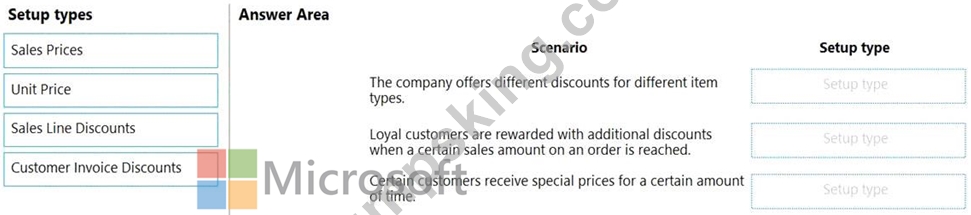
Answer:
Explanation:
Explanation
Graphical user interface, application Description automatically generated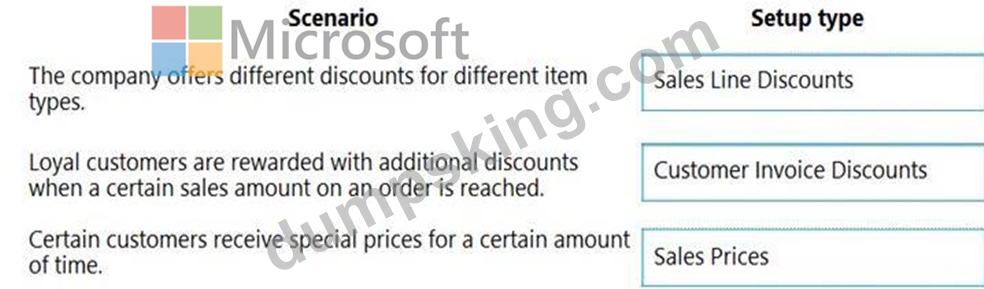
Reference:
https://usedynamics.com/business-central/sales/item-sales-prices/
NEW QUESTION # 157
You are setting up the general journals and batches for an accounting department.
The accounting department has multiple users who will work simultaneously within different general journals.
You need to set up the different journal templates and batches for each user according to the company's requirements.
Which options should you use? To answer, drag the appropriate options to the correct requirements. Each option may be used once, more than once, or not at all. You may need to drag the split bar between panes or scroll to view content.
NOTE: Each correct selection is worth one point.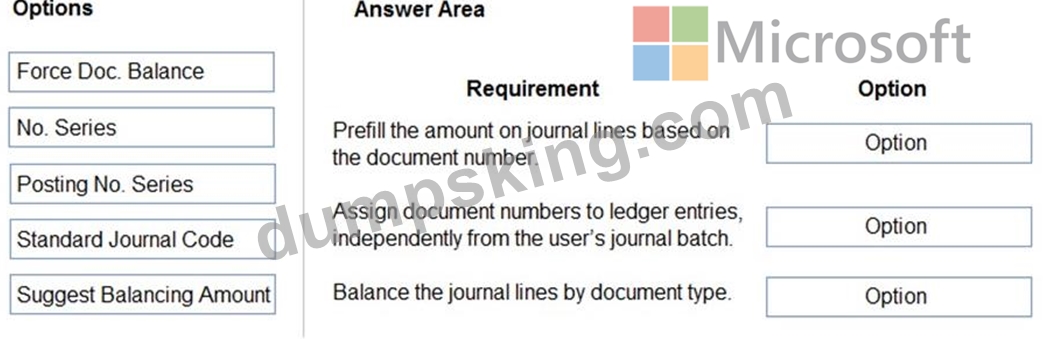
Answer:
Explanation: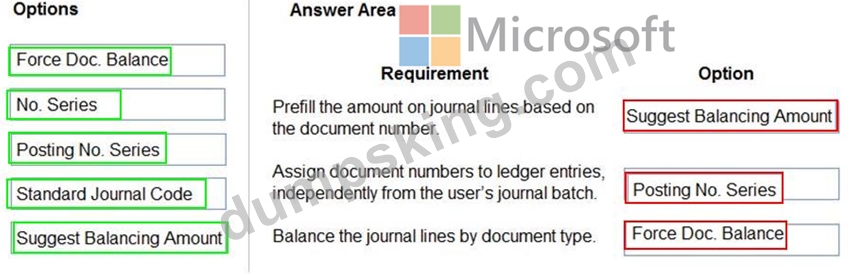
Reference:
https://docs.microsoft.com/en-us/learn/modules/general-journal-templates-dynamics-365-business-central/1-templates
https://docs.microsoft.com/en-us/learn/modules/general-journal-templates-dynamics-365-business-central/2-batches
NEW QUESTION # 158
You have a sales order with a quantity of 100 items.
You need to post a shipment with a quantity of 50 items from the sales order.
Which four actions should you perform in sequence? To answer, move the appropriate actions from the list of actions to the answer area and arrange them in the correct order.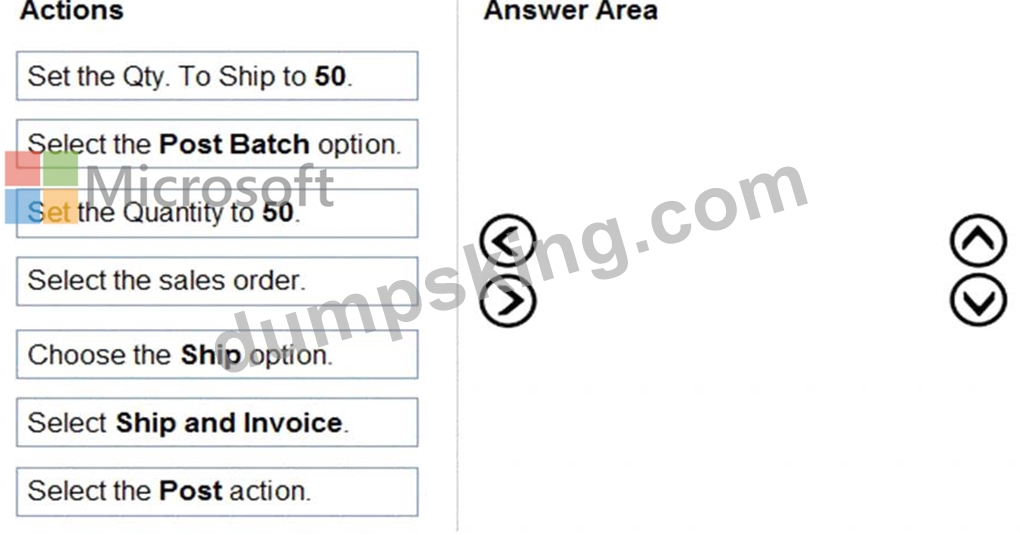
Answer:
Explanation: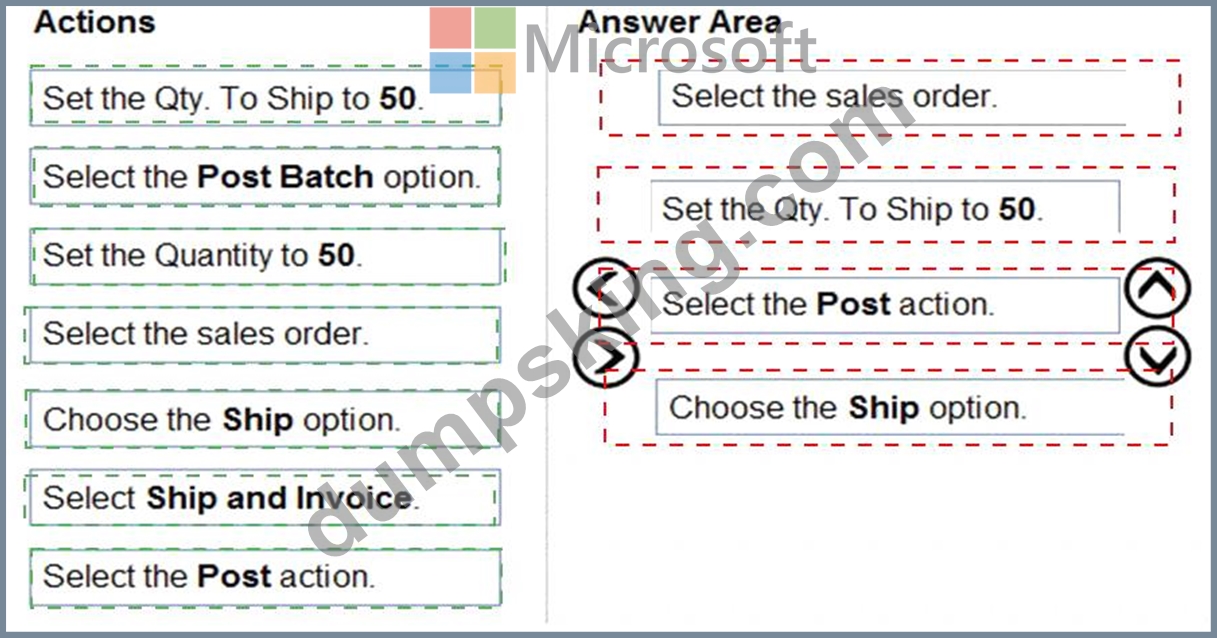
Explanation: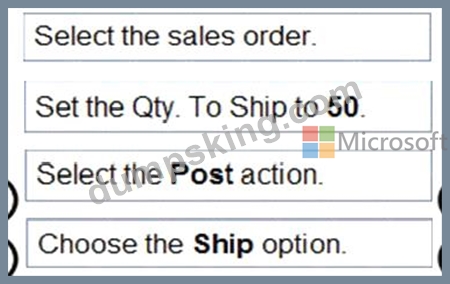
Reference:
https://usedynamics.com/intercompany/posting-partial-shipments/
NEW QUESTION # 159
You need to configure sales for the cash and carry desk.
What should you select?
- A. Payment Terms with a value of 0D for Due Date Calculation
- B. Direct Debit Mandate with a value of OneOff for Type of Payment
- C. Payment Service
- D. Payment Method with a value of Bank Account for Balance Account
Answer: A
Explanation:
The scenario describes cash and carry sales, where customers pay immediately at the desk and sales invoices must be posted as paid in full at the time of sale. In Dynamics 365 Business Central, this is achieved by setting Payment Terms that indicate no delay between invoice date and due date.
* Why D (Payment Terms = 0D)
* The Payment Terms setup in Business Central allows you to define how the Due Date is calculated.
* For cash and carry transactions, the invoice is due on the same day (zero days). Setting the Due Date Calculation to 0D ensures that the system always marks invoices as immediately due, reflecting the cash-and-carry business process.
* This aligns with requirements: "Invoices must be posted at the cash and carry desk at the time of sale" and "Invoices already paid in full should not appear as outstanding on aging reports."
* Why not A (Payment Service)
* Payment Services are used for integration with external services like PayPal or credit card gateways. Wide World Importers does not require a POS or online payment gateway-just simple cash handling at the desk.
* Why not B (Direct Debit Mandate)
* Direct Debit is used for recurring bank withdrawals (SEPA mandates, subscription-type payments). It does not apply to one-time, immediate cash payments.
* Why not C (Payment Method = Bank Account)
* While Payment Methods (e.g., Cash, Bank Transfer, Check) are also important for tracking how customers pay, the critical requirement in the scenario is ensuring the invoice is due immediately.
That is achieved by Payment Terms = 0D, not by Payment Method alone.
Best Practice Setup in Business Central for Cash & Carry:
* Payment Terms: 0D (ensures invoice due immediately).
* Payment Method: Cash (ensures posted directly against the cash account).
* Apply to invoices at posting: Invoices will automatically be shown as paid in full.
This combination ensures correct cash sales processing and eliminates the issue noted in the case study where invoices incorrectly appear in aging reports.
Microsoft References
* Set Up Payment Terms in Business Central
* Set Up Payment Methods in Business Central
* Work with Payment Transactions
Topic 3, Northwind Traders
Northwind Traders is an independent, family-owned business. The company distributes natural pet products in the Northwest region of the country/region. Products are purchased directly from manufacturers and distributed by using its own fleet of trucks.
When the company started, deliveries were within a three-hour radius of the warehouse. Due to regional growth, current deliveries require drivers to stay overnight on some routes. The company plans to open a second warehouse to expand the region and eliminate overnights for route drivers. The company also plans to hire a second group of employees to run operations in this new location. The finance and accounting teams will remain in the original location.
The company uses a third-party system for financials and order management. The finance department stated that the company's fiscal year begins on July 1 and ends on June 30. The mm/dd/yyyy date format is used.
As part of the expansion, the owner plans to upgrade to an ERP system and use Business Central to fulfill the company requirements and manage growth.
Orders
* Orders are emailed to customer service and manually keyed into the inventory system.
Pricing and discounts
* Customer pricing is determined by the customer market type. Customer market types are Retail, Veterinarian, and Breeder. Each customer is associated with only one market type.
* Vendors offer monthly promotions to customers by item, brand, or item category.
* Invoices should show each customer's base price, the discount amount, and the net price.
Accounts payable
* The company wants to expand vendor payment options in the new system.
Customers
* The sales team must be able to do the following:
o Quickly set up new customers with the proper settings based on customer type.
o Identify customers by market type. Customer posting groups will be used to identify which market the customer belongs to.
* Base price is determined by the customer market type.
* The sales department should receive a warning when entering the order if a customer is over their credit limit.
Sales
* Customer discounts are offered for specific time frames by item, brand, or product category. Discounts should be added to sales lines automatically.
* Discounts must post to a unique general ledger (G/L) account.
* The business needs to be able to track revenue by location, market, and product category dimensions.
Locations 100 and 200 will be set as default dimensions on the two warehouse locations. Food, treats, toys, and supplies are the required product categories, which will be set as default dimensions on the item cards.
Each customer card will have a default market dimension.
* The sales manager wants to delete canceled orders and automatically archive them.
Warehouse
* Orders will be fulfilled from two possible warehouse locations.
* Product will be transferred between locations by using transfer orders.
Sales invoices
* Invoices will be posted after delivery.
* Invoices will be emailed to the customer.
* The sales department must be able to quickly correct posted invoices for the following scenarios:
o Posted invoices that have not been paid
o Posted invoices that have been paid.
o Posted invoices created from sales orders.
O Posted invoices not created from sales orders.
Accounting
* The finance department requires that the company has 12 monthly accounting periods per fiscal year.
* Finance department users must be able to reconcile the accounts receivable (AR) subledger to the G/L account at month end.
* AR department users need the ability to settle and close invoices when customers take payment discounts after the payment discount date has passed. AR users should be allowed to accept or reject the payment tolerance.
* Accounts payable (AP) department users must be able to pay vendors by electronic funds transfer (EFT) and use a payment journal batch named EFT to process payments.
* When viewing G/L entries, the finance and accounting teams must be able to see debits and credits instead of a positive or negative amount.
* The company needs to be able to track expenses by department and location. The departments are sales, operations, and administration.
* AR must be able to correct cash application entries.
NEW QUESTION # 160
You are implementing Dynamics 365 Business Central.
You are creating an expense account for office supplies in the chart of accounts. The account may be used for purchase invoice transactions as well as general journal transactions.
You need to configure the remaining options for the account.
Which values should you use? To answer, select the appropriate options in the answer area.
NOTE: Each correct selection is worth one point.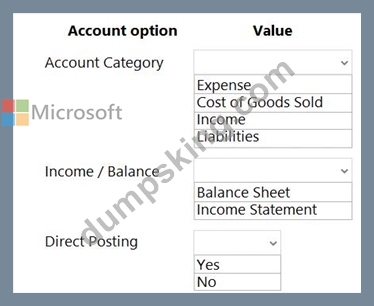
Answer:
Explanation: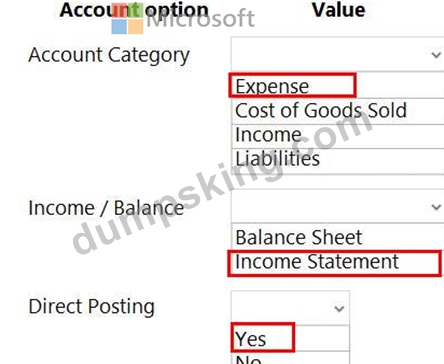
NEW QUESTION # 161
You are implementing Dynamics 365 Business Central for a customer. The local currency code (LCY) for the company is set to US dollars ($).
The customer plans to set up a bank account. The customer provides the following information for the account:
* Account number
* Name
* Address
* Bank account posting group
The account must meet the following requirements:
* Use US dollars.
* Use 9075 as the number of the next bank account statement for reconciliation in Business Central.
You need to set up the account for the customer.
Which values should you use? To answer, select the appropriate options in the answer area.
NOTE: Each correct selection is worth one point.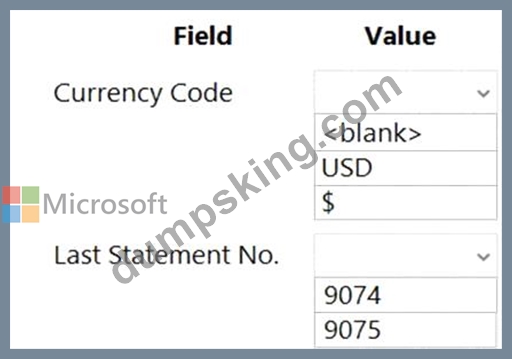
Answer:
Explanation: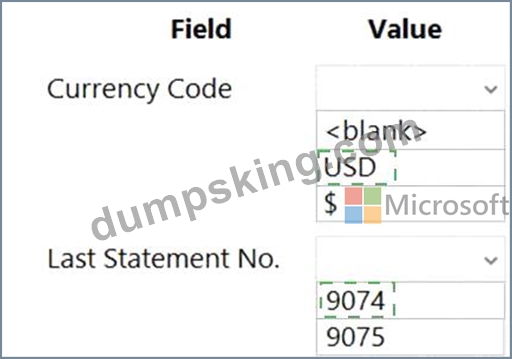
Explanation:
Graphical user interface, application, table Description automatically generated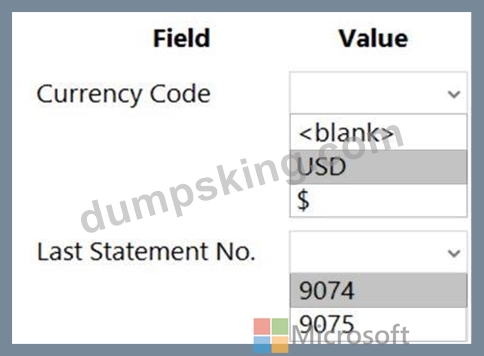
Reference:
https://docs.microsoft.com/en-gb/dynamics365/business-central/bank-how-reconcile-bank-accounts-separately
NEW QUESTION # 162
You need to create financial reports per company reporting requirements.
Which report configuration should you use to add the report descriptions lo financial reports? To answer, move the appropriate report configurations to the correct report descriptions. You may use each report configuration once, more than once, of not at all. You may need to move the split bar between panes or scroll to view content NOTE: Each correct selection is worth one point.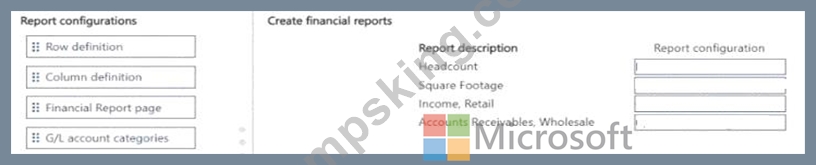
Answer:
Explanation: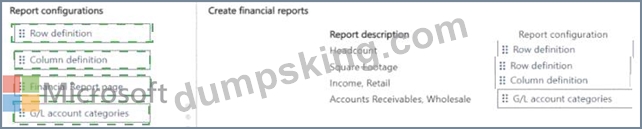
Explanation: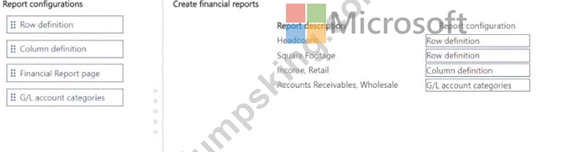
NEW QUESTION # 163
You are setting up the general journals and batches for an accounting department.
The accounting department has multiple users who will work simultaneously within different general journals.
You need to set up the different journal templates and batches for each user according to the company's requirements.
Which options should you use? To answer, drag the appropriate options to the correct requirements. Each option may be used once, more than once, or not at all. You may need to drag the split bar between panes or scroll to view content.
NOTE: Each correct selection is worth one point.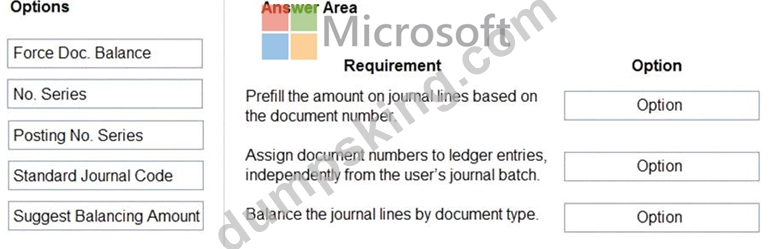
Answer:
Explanation: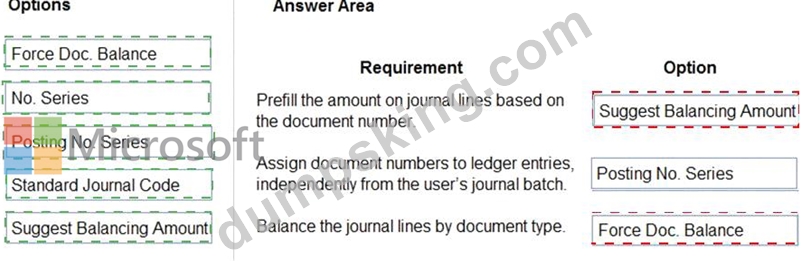
Explanation:
Graphical user interface, text, application Description automatically generatedup payment terms with a value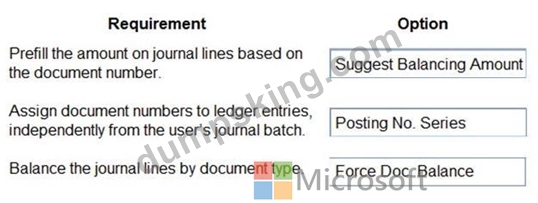
of
Reference:
https://docs.microsoft.com/en-us/learn/modules/general-journal-templates-dynamics-365-business-central/1-temp
https://docs.microsoft.com/en-us/learn/modules/general-journal-templates-dynamics-365-business-central/2-batc
NEW QUESTION # 164
You need to configure the new customer creation process.
Which two areas must you configure? Each correct answer presents part of the solution NOTE: Each correct selection is worth one point.
- A. Responsibility center
- B. Permissions
- C. Configuration worksheet
- D. Configuration template
Answer: B,D
Explanation:
Reference:
https://usedynamics.com/business-central/sales/create-customer-templates/
NEW QUESTION # 165
A company operates from India. The company procures materials from Sweden.
You need to set up invoice discount terms for a vendor based in Sweden.
Which three pieces of information should you enter? Each correct answer presents part of the solution.
NOTE: Each correct selection is worth one point.
- A. starting date
- B. discount percentage
- C. currency code
- D. minimum quantity
- E. minimum amount
Answer: B,C,E
Explanation:
Reference:
https://docs.microsoft.com/en-us/learn/modules/customer-discounts-dynamics-365-business-central/3-invoice
NEW QUESTION # 166
......
Certification Topics of MB-800 Exam PDF Recently Updated Questions: https://dumpstorrent.dumpsking.com/MB-800-testking-dumps.html
