

[May 13, 2024] DumpsKing DP-100 Exam Practice Test Questions (Updated 410 Questions)
Pass Microsoft DP-100 Exam Info and Free Practice Test
Microsoft DP-100 certification exam is designed to assess the skills and knowledge of data scientists and data engineers in designing and implementing data science solutions using Microsoft Azure technologies. Designing and Implementing a Data Science Solution on Azure certification is ideal for professionals who are looking to enhance their career in the field of data science and want to demonstrate their expertise in designing and implementing data science solutions on Azure.
Microsoft DP-100 (Designing and Implementing a Data Science Solution on Azure) certification exam is designed for data professionals who use Azure technologies to build and implement data science solutions. DP-100 exam measures the candidate's ability to design and implement data storage solutions, data processing solutions, and data analysis solutions using Azure technologies. Candidates who pass the DP-100 exam will receive the Microsoft Certified: Azure Data Scientist Associate certification.
NEW QUESTION # 113
You manage an Azure Machine Learning workspace named workspace 1 with a compute instance named computet.
You must remove a kernel named kernel 1 from computet1. You connect to compute 1 by using noa terminal window from workspace 1.
You need to enter a command in the terminal window to remove kernel 1.
Which command should you use? To answer, select the appropriate options in the answer area.
NOTE: Each correct selection it worth one point.
Answer:
Explanation:
NEW QUESTION # 114
You manage an Azure Machine Learning workspace. You create an experiment named experiment1 by using the Azure Machine Learning Python SDK v2 and MLflow.
For each of the following statements, select Yes if the statement is true. Otherwise, select No.
Answer:
Explanation:
NEW QUESTION # 115
You are performing clustering by using the K-means algorithm.
You need to define the possible termination conditions.
Which three conditions can you use? Each correct answer presents a complete solution.
NOTE: Each correct selection is worth one point.
- A. Centroids do not change between iterations.
- B. The residual sum of squares (RSS) rises above a threshold.
- C. The sum of distances between centroids reaches a maximum.
- D. A fixed number of iterations is executed.
- E. The residual sum of squares (RSS) falls below a threshold.
Answer: A,D,E
Explanation:
AD: The algorithm terminates when the centroids stabilize or when a specified number of iterations are completed.
C: A measure of how well the centroids represent the members of their clusters is the residual sum of squares or RSS, the squared distance of each vector from its centroid summed over all vectors. RSS is the objective function and our goal is to minimize it.
Reference:
https://docs.microsoft.com/en-us/azure/machine-learning/studio-module-reference/k-means-clustering
https://nlp.stanford.edu/IR-book/html/htmledition/k-means-1.html
NEW QUESTION # 116
You have a dataset that contains over 150 features. You use the dataset to train a Support Vector Machine (SVM) binary classifier.
You need to use the Permutation Feature Importance module in Azure Machine Learning Studio to compute a set of feature importance scores for the dataset.
In which order should you perform the actions? To answer, move all actions from the list of actions to the answer area and arrange them in the correct order.
Answer:
Explanation:
1 - Add a Two-Class Support Vector Machine module to initialize the SVM classifier.
2 - Add a dataset to the experiment
3 - Add a Split Data module to create training and test dataset.
4 - Add a Permutation Feature Importance module and connect to the trained model and test dataset.
5 - Set the Metric for measuring performance property to Classification - Accuracy and then run the experiment.
Reference:
https://docs.microsoft.com/en-us/azure/machine-learning/studio-module-reference/two-class-support-vector-machine
https://docs.microsoft.com/en-us/azure/machine-learning/studio-module-reference/permutation-feature-importance
NEW QUESTION # 117
You train classification and regression models by using automated machine learning.
You must evaluate automated machine learning experiment results. The results include how a classification model is making systematic errors in its predictions and the relationship between the target feature and the regression model's predictions. You must use charts generated by automated machine learning.
You need to choose a chart type for each model type.
Which chart types should you use? To answer, select the appropriate options in the answer area.
NOTE: Each correct selection is worth one point.
Answer:
Explanation:
see the answer below.
Explanation
See below image
NEW QUESTION # 118
You are creating data wrangling and model training solutions in an Azure Machine Learning workspace.
You must use the same Python notebook to perform both data wrangling and model training.
You need to use the Azure Machine Learning Python SDK v2 to define and configure the Synapse Spark pool asynchronously in the workspace as dedicated compute How should you complete the rode segment? To answer, select the appropriate options in the answer area.
NOTE: Lach correct selection is worth one point.
Answer:
Explanation:
NEW QUESTION # 119
You are performing feature scaling by using the scikit-learn Python library for x.1 x2, and x3 features.
Original and scaled data is shown in the following image.
Use the drop-down menus to select the answer choice that answers each question based on the information presented in the graphic.
NOTE: Each correct selection is worth one point.
Answer:
Explanation:
Reference:
http://benalexkeen.com/feature-scaling-with-scikit-learn/
NEW QUESTION # 120
You plan to use a Deep Learning Virtual Machine (DLVM) to train deep learning models using Compute Unified Device Architecture (CUDA) computations.
You need to configure the DLVM to support CUDA.
What should you implement?
- A. Computer Processing Unit (CPU) speed increase by using overcloking
- B. High Random Access Memory (RAM) configuration
- C. Intel Software Guard Extensions (Intel SGX) technology
- D. Solid State Drives (SSD)
- E. Graphic Processing Unit (GPU)
Answer: E
Explanation:
Explanation
A Deep Learning Virtual Machine is a pre-configured environment for deep learning using GPU instances.
References:
https://azuremarketplace.microsoft.com/en-au/marketplace/apps/microsoft-ads.dsvm-deep-learning
NEW QUESTION # 121
Note: This question is part of a series of questions that present the same scenario. Each question in the series contains a unique solution that might meet the stated goals. Some question sets might have more than one correct solution, while others might not have a correct solution.
After you answer a question in this section, you will NOT be able to return to it. As a result, these questions will not appear in the review screen.
You are creating a new experiment in Azure Learning learning Studio.
One class has a much smaller number of observations than the other classes in the training You need to select an appropriate data sampling strategy to compensate for the class imbalance.
Solution: You use the Synthetic Minority Oversampling Technique (SMOTE) sampling mode.
Does the solution meet the goal?
- A. No
- B. Yes
Answer: B
Explanation:
Explanation
SMOTE is used to increase the number of underepresented cases in a dataset used for machine learning.
SMOTE is a better way of increasing the number of rare cases than simply duplicating existing cases.
References:
https://docs.microsoft.com/en-us/azure/machine-learning/studio-module-reference/smote
NEW QUESTION # 122
You create an Azure Machine learning workspace. The workspace contains a folder named src. The folder contains a Python script named script 1 .py.
You use the Azure Machine Learning Python SDK v2 to create a control script. You must use the control script to run script l.py as part of a training job.
You need to complete the section of script that defines the job parameters.
How should you complete the script? To answer, select the appropriate options in the answer area.
NOTE: Each correct selection is worth one point.
Answer:
Explanation:
Explanation
NEW QUESTION # 123
You need to implement a scaling strategy for the local penalty detection data.
Which normalization type should you use?
- A. Batch
- B. Cosine
- C. Weight
- D. Streaming
Answer: A
Explanation:
Post batch normalization statistics (PBN) is the Microsoft Cognitive Toolkit (CNTK) version of how to evaluate the population mean and variance of Batch Normalization which could be used in inference Original Paper.
In CNTK, custom networks are defined using the BrainScriptNetworkBuilder and described in the CNTK network description language "BrainScript." Scenario:
Local penalty detection models must be written by using BrainScript.
References:
https://docs.microsoft.com/en-us/cognitive-toolkit/post-batch-normalization-statistics Prepare data for modeling Testlet 2 Case study This is a case study. Case studies are not timed separately. You can use as much exam time as you would like to complete each case. However, there may be additional case studies and sections on this exam. You must manage your time to ensure that you are able to complete all questions included on this exam in the time provided.
To answer the questions included in a case study, you will need to reference information that is provided in the case study. Case studies might contain exhibits and other resources that provide more information about the scenario that is described in the case study. Each question is independent of the other questions in this case study.
At the end of this case study, a review screen will appear. This screen allows you to review your answers and to make changes before you move to the next section of the exam. After you begin a new section, you cannot return to this section.
To start the case study
To display the first question in this case study, click the Next button. Use the buttons in the left pane to explore the content of the case study before you answer the questions. Clicking these buttons displays information such as business requirements, existing environment, and problem statements. If the case study has an All Information tab, note that the information displayed is identical to the information displayed on the subsequent tabs. When you are ready to answer a question, click the Question button to return to the question.
Overview
You are a data scientist for Fabrikam Residences, a company specializing in quality private and commercial property in the Unites States. Fabrikam Residences is considering expanding into Europe and has asked you to investigate prices for private residences in major European cities.
You use Azure Machine Learning Studio to measure the median value of properties. You produce a regression model to predict property prices by using the Linear Regression and Bayesian Linear Regression modules.
Datasets
There are two datasets in CSV format that contain property details for two cities, London and Paris. You add both files to Azure Machine Learning Studio as separate datasets to the starting point for an experiment. Both datasets contain the following columns:
An initial investigation shows that the datasets are identical in structure apart from the MedianValue column.
The smaller Paris dataset contains the MedianValue in text format, whereas the larger London dataset contains the MedianValue in numerical format.
Data issues
Missing values
The AccessibilityToHighway column in both datasets contains missing values. The missing data must be replaced with new data so that it is modeled conditionally using the other variables in the data before filling in the missing values.
Columns in each dataset contain missing and null values. The datasets also contain many outliers. The Age column has a high proportion of outliers. You need to remove the rows that have outliers in the Age column.
The MedianValue and AvgRoomsInHouse columns both hold data in numeric format. You need to select a feature selection algorithm to analyze the relationship between the two columns in more detail.
Model fit
The model shows signs of overfitting. You need to produce a more refined regression model that reduces the overfitting.
Experiment requirements
You must set up the experiment to cross-validate the Linear Regression and Bayesian Linear Regression modules to evaluate performance. In each case, the predictor of the dataset is the column named MedianValue. You must ensure that the datatype of the MedianValue column of the Paris dataset matches the structure of the London dataset.
You must prioritize the columns of data for predicting the outcome. You must use non-parametric statistics to measure relationships.
You must a feature selection algorithm to analyze the relationship between the MediaValue and AvgRoomsinHouse columns.
Model training
Permutation Feature Importance
Given a trained model and a test dataset, you must compute the Permutation Feature Importance scores of feature variables. You must be determined the absolute fit for the model.
Hyperparameters
You must configure hyperparameters in the model learning process to speed the learning phase. In addition, this configuration should cancel the lowest performing runs at each evaluation interval, thereby directing effort and resources towards models that are more likely to be successful.
You are concerned that the model might not efficiently use compute resources in hyperparameter tuning. You also are concerned that the model might prevent an increase in the overall tuning time. Therefore, must implement an early stopping criterion on models that provides savings without terminating promising jobs.
Testing
You must produce multiple partitions of a dataset based on sampling using the Partition and Sample module in Azure Machine Learning Studio.
Cross-validation
You must create three equal partitions for cross-validation. You must also configure the cross-validation process so that the rows in the test and training datasets are divided evenly by properties that are near each city's main river. You must complete this task before the data goes through the sampling process.
Linear regression module
When you train a Linear Regression module, you must determine the best features to use in a model. You can choose standard metrics provided to measure performance before and after the feature importance process completes. The distribution of features across multiple training models must be consistent.
Data visualization
You need to provide the test results to the Fabrikam Residences team. You create data visualizations to aid in presenting the results.
You must produce a Receiver Operating Characteristic (ROC) curve to conduct a diagnostic test evaluation of the model. You need to select appropriate methods for producing the ROC curve in Azure Learning Studio to compare the Two-Class Decision Forest and the Two-Class Decision Jungle modules with one another.
NEW QUESTION # 124 
You need to record the row count as a metric named row_count that can be returned using the get_metrics method of the Run object after the experiment run completes. Which code should you use?
- A. run.tag('row_count', rows)
- B. run.log_table('row_count', rows)
- C. run.upload_file('row_count', './data.csv')
- D. run.log('row_count', rows)
- E. run.log_row('row_count', rows)
Answer: D
Explanation:
Explanation
Log a numerical or string value to the run with the given name using log(name, value, description=''). Logging a metric to a run causes that metric to be stored in the run record in the experiment. You can log the same metric multiple times within a run, the result being considered a vector of that metric.
Example: run.log("accuracy", 0.95)
Reference:
https://docs.microsoft.com/en-us/python/api/azureml-core/azureml.core.run
NEW QUESTION # 125
You are using the Hyperdrive feature in Azure Machine Learning to train a model.
You configure the Hyperdrive experiment by running the following code:
For each of the following statements, select Yes if the statement is true. Otherwise, select No.
NOTE: Each correct selection is worth one point.
Answer:
Explanation:
Reference:
https://docs.microsoft.com/en-us/azure/machine-learning/how-to-tune-hyperparameters
NEW QUESTION # 126
You need to define an evaluation strategy for the crowd sentiment models.
Which three actions should you perform in sequence? To answer, move the appropriate actions from the list of actions to the answer area and arrange them in the correct order.
Answer:
Explanation: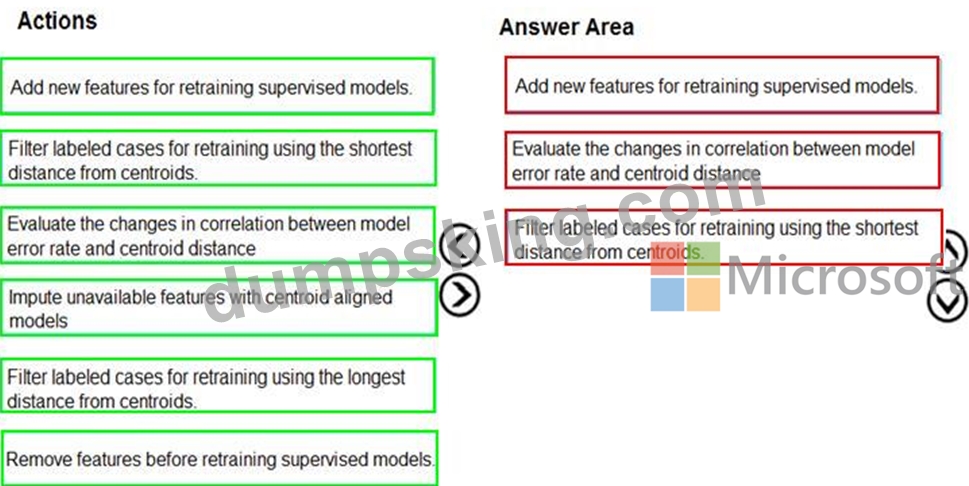
Explanation:
Scenario:
Experiments for local crowd sentiment models must combine local penalty detection data.
Crowd sentiment models must identify known sounds such as cheers and known catch phrases. Individual crowd sentiment models will detect similar sounds.
Note: Evaluate the changed in correlation between model error rate and centroid distance In machine learning, a nearest centroid classifier or nearest prototype classifier is a classification model that assigns to observations the label of the class of training samples whose mean (centroid) is closest to the observation.
References:
https://en.wikipedia.org/wiki/Nearest_centroid_classifier
https://docs.microsoft.com/en-us/azure/machine-learning/studio-module-reference/sweep-clustering
NEW QUESTION # 127
You are working on a classification task. You have a dataset indicating whether a student would like to play soccer and associated attributes. The dataset includes the following columns:
You need to classify variables by type.
Which variable should you add to each category? To answer, select the appropriate options in the answer area.
NOTE: Each correct selection is worth one point.
Answer:
Explanation:
Reference:
https://www.edureka.co/blog/classification-algorithms/
NEW QUESTION # 128
Note: This question is part of a series of questions that present the same scenario. Each question in the series contains a unique solution that might meet the stated goals. Some question sets might have more than one correct solution, while others might not have a correct solution.
After you answer a question in this section, you will NOT be able to return to it. As a result, these questions will not appear in the review screen.
An IT department creates the following Azure resource groups and resources:
The IT department creates an Azure Kubernetes Service (AKS)-based inference compute target named aks-cluster in the Azure Machine Learning workspace. You have a Microsoft Surface Book computer with a GPU. Python 3.6 and Visual Studio Code are installed.
You need to run a script that trains a deep neural network (DNN) model and logs the loss and accuracy metrics.
Solution: Install the Azure ML SDK on the Surface Book. Run Python code to connect to the workspace. Run the training script as an experiment on the aks-cluster compute target.
Does the solution meet the goal?
- A. Yes
- B. No
Answer: B
Explanation:
Explanation
Need to attach the mlvm virtual machine as a compute target in the Azure Machine Learning workspace.
Reference:
https://docs.microsoft.com/en-us/azure/machine-learning/concept-compute-target
NEW QUESTION # 129
......
Pass Your Microsoft Exam with DP-100 Exam Dumps: https://dumpstorrent.dumpsking.com/DP-100-testking-dumps.html
