

2024 Realistic DumpsKing DP-203 Dumps PDF - 100% Passing Guarantee
Free Microsoft DP-203 Exam Questions and Answer
Microsoft DP-203 certification exam is an important credential for data engineers who work with Azure. It validates their skills and knowledge in a highly sought-after area of expertise and can help them advance their careers in this field.
NEW QUESTION # 24
You have the following Azure Stream Analytics query.
For each of the following statements, select Yes if the statement is true. Otherwise, select No.
NOTE: Each correct selection is worth one point.
Answer:
Explanation:
Reference:
https://azure.microsoft.com/en-in/blog/maximize-throughput-with-repartitioning-in-azure-stream-analytics/
NEW QUESTION # 25
You need to build a solution to ensure that users can query specific files in an Azure Data Lake Storage Gen2 account from an Azure Synapse Analytics serverless SQL pool.
Which three actions should you perform in sequence? To answer, move the appropriate actions from the list of actions to the answer area and arrange them in the correct order.
NOTE: More than one order of answer choices is correct. You will receive credit for any of the correct orders you select.
Answer:
Explanation:
1 - Create an external data source
2 - Create an external file format object
3 - Creat an external table
Reference:
https://docs.microsoft.com/en-us/azure/synapse-analytics/sql/develop-tables-external-tables
NEW QUESTION # 26
You have a data model that you plan to implement in a data warehouse in Azure Synapse Analytics as shown in the following exhibit.
All the dimension tables will be less than 2 GB after compression, and the fact table will be approximately 6 TB.
Which type of table should you use for each table? To answer, select the appropriate options in the answer area.
NOTE: Each correct selection is worth one point.
Answer:
Explanation:
Explanation
NEW QUESTION # 27
You have a table in an Azure Synapse Analytics dedicated SQL pool. The table was created by using the following Transact-SQL statement.
You need to alter the table to meet the following requirements:
* Ensure that users can identify the current manager of employees.
* Support creating an employee reporting hierarchy for your entire company.
* Provide fast lookup of the managers' attributes such as name and job title.
Which column should you add to the table?
- A. [ManagerEmployeeKey] [int] NULL
- B. [ManagerEmployeeID] [int] NULL
- C. [ManagerName] [varchar](200) NULL
- D. [ManagerEmployeeID] [smallint] NULL
Answer: B
Explanation:
Use the same definition as the EmployeeID column.
Reference:
https://docs.microsoft.com/en-us/analysis-services/tabular-models/hierarchies-ssas-tabular
NEW QUESTION # 28
You have an Azure subscription that contains an Azure Data Lake Storage account. The storage account contains a data lake named DataLake1.
You plan to use an Azure data factory to ingest data from a folder in DataLake1, transform the data, and land the data in another folder.
You need to ensure that the data factory can read and write data from any folder in the DataLake1 file system. The solution must meet the following requirements:
Minimize the risk of unauthorized user access.
Use the principle of least privilege.
Minimize maintenance effort.
How should you configure access to the storage account for the data factory? To answer, select the appropriate options in the answer area.
NOTE: Each correct selection is worth one point.
Answer:
Explanation:
Reference:
https://docs.microsoft.com/en-us/azure/active-directory/managed-identities-azure-resources/overview
https://docs.microsoft.com/en-us/azure/data-factory/connector-azure-data-lake-storage
NEW QUESTION # 29
You have data stored in thousands of CSV files in Azure Data Lake Storage Gen2. Each file has a header row followed by a properly formatted carriage return (/r) and line feed (/n).
You are implementing a pattern that batch loads the files daily into an enterprise data warehouse in Azure Synapse Analytics by using PolyBase.
You need to skip the header row when you import the files into the data warehouse. Before building the loading pattern, you need to prepare the required database objects in Azure Synapse Analytics.
Which three actions should you perform in sequence? To answer, move the appropriate actions from the list of actions to the answer area and arrange them in the correct order.
NOTE: Each correct selection is worth one point
Answer:
Explanation:
Explanation
A picture containing timeline Description automatically generated
Step 1: Create an external data source that uses the abfs location
Create External Data Source to reference Azure Data Lake Store Gen 1 or 2 Step 2: Create an external file format and set the First_Row option.
Create External File Format.
Step 3: Use CREATE EXTERNAL TABLE AS SELECT (CETAS) and configure the reject options to specify reject values or percentages To use PolyBase, you must create external tables to reference your external data.
Use reject options.
Note: REJECT options don't apply at the time this CREATE EXTERNAL TABLE AS SELECT statement is run. Instead, they're specified here so that the database can use them at a later time when it imports data from the external table. Later, when the CREATE TABLE AS SELECT statement selects data from the external table, the database will use the reject options to determine the number or percentage of rows that can fail to import before it stops the import.
Reference:
https://docs.microsoft.com/en-us/sql/relational-databases/polybase/polybase-t-sql-objects
https://docs.microsoft.com/en-us/sql/t-sql/statements/create-external-table-as-select-transact-sql
NEW QUESTION # 30
You have an Azure Synapse Analytics workspace named WS1 that contains an Apache Spark pool named Pool1.
You plan to create a database named D61 in Pool1.
You need to ensure that when tables are created in DB1, the tables are available automatically as external tables to the built-in serverless SQL pod.
Which format should you use for the tables in DB1?
- A. JSON
- B. ORC
- C. Parquet
- D. CSV
Answer: C
Explanation:
Explanation
Serverless SQL pool can automatically synchronize metadata from Apache Spark. A serverless SQL pool database will be created for each database existing in serverless Apache Spark pools.
For each Spark external table based on Parquet or CSV and located in Azure Storage, an external table is created in a serverless SQL pool database.
Reference:
https://docs.microsoft.com/en-us/azure/synapse-analytics/sql/develop-storage-files-spark-tables
NEW QUESTION # 31
You have an Azure Synapse Analytics dedicated SQL pool that contains the users shown in the following table.
User1 executes a query on the database, and the query returns the results shown in the following exhibit.
User1 is the only user who has access to the unmasked data.
Use the drop-down menus to select the answer choice that completes each statement based on the information presented in the graphic.
NOTE: Each correct selection is worth one point.
Answer:
Explanation:
Reference:
https://docs.microsoft.com/en-us/azure/azure-sql/database/dynamic-data-masking-overview
NEW QUESTION # 32
You are designing an Azure Stream Analytics solution that receives instant messaging data from an Azure Event Hub.
You need to ensure that the output from the Stream Analytics job counts the number of messages per time zone every 15 seconds.
How should you complete the Stream Analytics query? To answer, select the appropriate options in the answer are a.
NOTE: Each correct selection is worth one point.
Answer:
Explanation:
Reference:
https://docs.microsoft.com/en-us/azure/stream-analytics/stream-analytics-window-functions
NEW QUESTION # 33
You have an Azure subscription.
You need to deploy an Azure Data Lake Storage Gen2 Premium account. The solution must meet the following requirements:
* Blobs that are older than 365 days must be deleted.
* Administrator efforts must be minimized.
* Costs must be minimized
What should you use? To answer, select the appropriate options in the answer area. NOTE Each correct selection is worth one point.
Answer:
Explanation:
Explanation
https://learn.microsoft.com/en-us/azure/storage/blobs/premium-tier-for-data-lake-storage
NEW QUESTION # 34
You have the following table named Employees.
You need to calculate the employee_type value based on the hire_date value.
How should you complete the Transact-SQL statement? To answer, drag the appropriate values to the correct targets. Each value may be used once, more than once, or not at all. You may need to drag the split bar between panes or scroll to view content.
NOTE: Each correct selection is worth one point.
Answer:
Explanation:
Explanation
Graphical user interface, text, application Description automatically generated
Box 1: CASE
CASE evaluates a list of conditions and returns one of multiple possible result expressions.
CASE can be used in any statement or clause that allows a valid expression. For example, you can use CASE in statements such as SELECT, UPDATE, DELETE and SET, and in clauses such as select_list, IN, WHERE, ORDER BY, and HAVING.
Syntax: Simple CASE expression:
CASE input_expression
WHEN when_expression THEN result_expression [ ...n ]
[ ELSE else_result_expression ]
END
Box 2: ELSE
Reference:
https://docs.microsoft.com/en-us/sql/t-sql/language-elements/case-transact-sql
NEW QUESTION # 35
You have an Azure Data Factory pipeline that has the activities shown in the following exhibit.
Use the drop-down menus to select the answer choice that completes each statement based on the information presented in the graphic.
NOTE: Each correct selection is worth one point.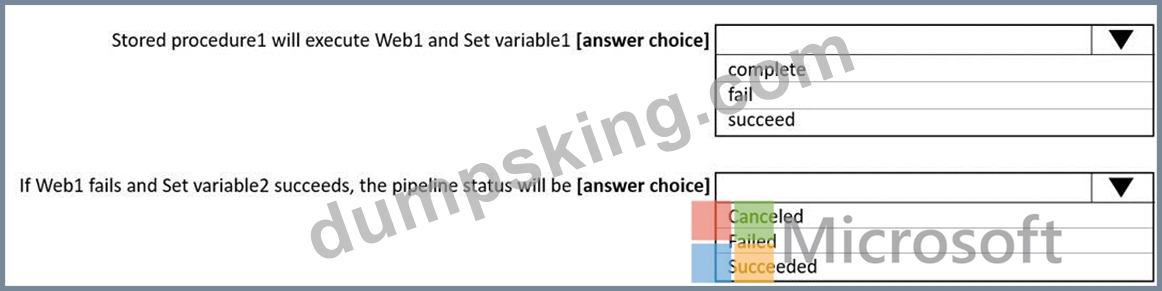
Answer:
Explanation:
Reference:
https://datasavvy.me/2021/02/18/azure-data-factory-activity-failures-and-pipeline-outcomes/
NEW QUESTION # 36
You plan to create a table in an Azure Synapse Analytics dedicated SQL pool.
Data in the table will be retained for five years. Once a year, data that is older than five years will be deleted.
You need to ensure that the data is distributed evenly across partitions. The solution must minimize the amount of time required to delete old data.
How should you complete the Transact-SQL statement? To answer, drag the appropriate values to the correct targets. Each value may be used once, more than once, or not at all. You may need to drag the split bar between panes or scroll to view content.
NOTE: Each correct selection is worth one point.
Answer:
Explanation:
Explanation
Box 1: HASH
Box 2: OrderDateKey
In most cases, table partitions are created on a date column.
A way to eliminate rollbacks is to use Metadata Only operations like partition switching for data management.
For example, rather than execute a DELETE statement to delete all rows in a table where the order_date was in October of 2001, you could partition your data early. Then you can switch out the partition with data for an empty partition from another table.
Reference:
https://docs.microsoft.com/en-us/sql/t-sql/statements/create-table-azure-sql-data-warehouse
https://docs.microsoft.com/en-us/azure/synapse-analytics/sql/best-practices-dedicated-sql-pool
NEW QUESTION # 37
You have an Azure subscription.
You need to deploy an Azure Data Lake Storage Gen2 Premium account. The solution must meet the following requirements:
* Blobs that are older than 365 days must be deleted.
* Administrator efforts must be minimized.
* Costs must be minimized
What should you use? To answer, select the appropriate options in the answer are a. NOTE Each correct selection is worth one point.
Answer:
Explanation:
NEW QUESTION # 38
You have an Azure Data Lake Storage Gen2 container.
Data is ingested into the container, and then transformed by a data integration application. The data is NOT modified after that. Users can read files in the container but cannot modify the files.
You need to design a data archiving solution that meets the following requirements:
* New data is accessed frequently and must be available as quickly as possible.
* Data that is older than five years is accessed infrequently but must be available within one second when requested.
* Data that is older than seven years is NOT accessed. After seven years, the data must be persisted at the lowest cost possible.
* Costs must be minimized while maintaining the required availability.
How should you manage the data? To answer, select the appropriate options in the answer area.
NOTE: Each correct selection is worth one point
Answer:
Explanation:
Explanation
Box 1: Move to cool storage
Box 2: Move to archive storage
Archive - Optimized for storing data that is rarely accessed and stored for at least 180 days with flexible latency requirements, on the order of hours.
The following table shows a comparison of premium performance block blob storage, and the hot, cool, and archive access tiers.
Reference:
https://docs.microsoft.com/en-us/azure/storage/blobs/storage-blob-storage-tiers Explanation:
Box 1: Replicated
Replicated tables are ideal for small star-schema dimension tables, because the fact table is often distributed on a column that is not compatible with the connected dimension tables. If this case applies to your schema, consider changing small dimension tables currently implemented as round-robin to replicated.
Box 2: Replicated
Box 3: Replicated
Box 4: Hash-distributed
For Fact tables use hash-distribution with clustered columnstore index. Performance improves when two hash tables are joined on the same distribution column.
Reference:
https://azure.microsoft.com/en-us/updates/reduce-data-movement-and-make-your-queries-more-efficient-with-th
https://azure.microsoft.com/en-us/blog/replicated-tables-now-generally-available-in-azure-sql-data-warehouse/
NEW QUESTION # 39
You build an Azure Data Factory pipeline to move data from an Azure Data Lake Storage Gen2 container to a database in an Azure Synapse Analytics dedicated SQL pool.
Data in the container is stored in the following folder structure.
/in/{YYYY}/{MM}/{DD}/{HH}/{mm}
The earliest folder is /in/2021/01/01/00/00. The latest folder is /in/2021/01/15/01/45.
You need to configure a pipeline trigger to meet the following requirements:
Existing data must be loaded.
Data must be loaded every 30 minutes.
Late-arriving data of up to two minutes must he included in the load for the time at which the data should have arrived.
How should you configure the pipeline trigger? To answer, select the appropriate options in the answer area.
NOTE: Each correct selection is worth one point.
Answer:
Explanation:
Explanation
Box 1: Tumbling window
To be able to use the Delay parameter we select Tumbling window.
Box 2:
Recurrence: 30 minutes, not 32 minutes
Delay: 2 minutes.
The amount of time to delay the start of data processing for the window. The pipeline run is started after the expected execution time plus the amount of delay. The delay defines how long the trigger waits past the due time before triggering a new run. The delay doesn't alter the window startTime.
Reference:
https://docs.microsoft.com/en-us/azure/data-factory/how-to-create-tumbling-window-trigger
NEW QUESTION # 40
You have an Azure subscription.
You need to deploy an Azure Data Lake Storage Gen2 Premium account. The solution must meet the following requirements:
* Blobs that are older than 365 days must be deleted.
* Administrator efforts must be minimized.
* Costs must be minimized
What should you use? To answer, select the appropriate options in the answer are a. NOTE Each correct selection is worth one point.
Answer:
Explanation:
NEW QUESTION # 41
You use Azure Data Factory to prepare data to be queried by Azure Synapse Analytics serverless SQL pools.
Files are initially ingested into an Azure Data Lake Storage Gen2 account as 10 small JSON files. Each file contains the same data attributes and data from a subsidiary of your company.
You need to move the files to a different folder and transform the data to meet the following requirements:
Provide the fastest possible query times.
Automatically infer the schema from the underlying files.
How should you configure the Data Factory copy activity? To answer, select the appropriate options in the answer area.
NOTE: Each correct selection is worth one point.
Answer:
Explanation:
Reference:
https://docs.microsoft.com/en-us/azure/storage/blobs/data-lake-storage-introduction
https://docs.microsoft.com/en-us/azure/data-factory/format-parquet
NEW QUESTION # 42
You are designing a streaming data solution that will ingest variable volumes of data.
You need to ensure that you can change the partition count after creation.
Which service should you use to ingest the data?
- A. Azure Event Hubs Dedicated
- B. Azure Data Factory
- C. Azure Synapse Analytics
- D. Azure Stream Analytics
Answer: D
Explanation:
You can't change the partition count for an event hub after its creation except for the event hub in a dedicated cluster.
Reference:
https://docs.microsoft.com/en-us/azure/event-hubs/event-hubs-features
NEW QUESTION # 43
You are designing an Azure Stream Analytics solution that receives instant messaging data from an Azure Event Hub.
You need to ensure that the output from the Stream Analytics job counts the number of messages per time zone every 15 seconds.
How should you complete the Stream Analytics query? To answer, select the appropriate options in the answer area.
NOTE: Each correct selection is worth one point.
Answer:
Explanation:
Reference:
https://docs.microsoft.com/en-us/azure/stream-analytics/stream-analytics-window-functions
NEW QUESTION # 44
You have an Apache Spark DataFrame named temperatures. A sample of the data is shown in the following table.
You need to produce the following table by using a Spark SQL query.
How should you complete the query? To answer, drag the appropriate values to the correct targets. Each value may be used once, more than once, or not at all. You may need to drag the split bar between panes or scroll to view content.
NOTE: Each correct selection is worth one point.
Answer:
Explanation:
Explanation
Text Description automatically generated
Box 1: PIVOT
PIVOT rotates a table-valued expression by turning the unique values from one column in the expression into multiple columns in the output. And PIVOT runs aggregations where they're required on any remaining column values that are wanted in the final output.
Reference:
https://learnsql.com/cookbook/how-to-convert-an-integer-to-a-decimal-in-sql-server/
https://docs.microsoft.com/en-us/sql/t-sql/queries/from-using-pivot-and-unpivot
NEW QUESTION # 45
You have an Azure data factory.
You need to examine the pipeline failures from the last 60 days.
What should you use?
- A. the Resource health blade for the Data Factory resource
- B. the Monitor & Manage app in Data Factory
- C. Azure Monitor
- D. the Activity log blade for the Data Factory resource
Answer: C
Explanation:
Data Factory stores pipeline-run data for only 45 days. Use Azure Monitor if you want to keep that data for a longer time.
Reference:
https://docs.microsoft.com/en-us/azure/data-factory/monitor-using-azure-monitor
NEW QUESTION # 46
You have an Azure Data Lake Storage Gen2 account that contains a JSON file for customers. The file contains two attributes named FirstName and LastName.
You need to copy the data from the JSON file to an Azure Synapse Analytics table by using Azure Databricks.
A new column must be created that concatenates the FirstName and LastName values.
You create the following components:
* A destination table in Azure Synapse
* An Azure Blob storage container
* A service principal
Which five actions should you perform in sequence next in is Databricks notebook? To answer, move the appropriate actions from the list of actions to the answer area and arrange them in the correct order.
Answer:
Explanation:
Explanation
1) mount onto DBFS
2) read into data frame
3) transform data frame
4) specify temporary folder
5) write the results to table in in Azure Synapse
https://docs.databricks.com/data/data-sources/azure/azure-datalake-gen2.html
https://docs.microsoft.com/en-us/azure/databricks/scenarios/databricks-extract-load-sql-data-warehouse
NEW QUESTION # 47
......
Why do you need to get Microsoft DP-203 Exam
Are you ready to take the Data Engineering on Microsoft Azure Exam
DP-203 Exam: Key Points and Focus Areas
The Microsoft Data Platform, or MDP, is a collection of products and services that primarily target companies whose business involves large volumes of data. These companies are often referred to as data-driven businesses. The MDP helps such businesses store, process, and analyze the massive amounts of data that their operations produce. The Microsoft Data Platform Certification (Microsoft DP-203) exam tests a candidate's knowledge of the Microsoft technologies that are used to build a cloud computing infrastructure for Big Data analytics. Free demo material that helps with the preparation for the DP-203 exam includes sample questions and answers, practice exams, and a training guide. Microsoft DP-203 Dumps provide all the test-taking tools necessary for passing the DP-203 exam, including a test engine and a simulation mode. If you are reading this article it means you are interested in pursuing a Microsoft certification path or already have one. Great! You've taken an important first step to become a Data Engineer on Microsoft Azure certification.
Verified DP-203 dumps Q&As Latest DP-203 Download: https://dumpstorrent.dumpsking.com/DP-203-testking-dumps.html
