

Microsoft DP-203 Test Engine Practice Test Questions, Exam Dumps
100% Free DP-203 Daily Practice Exam With 335 Questions
To take the DP-203 exam, candidates must have a good understanding of data engineering concepts, such as data modeling, data integration, and data transformation. They should also have experience working with big data technologies, such as Hadoop, Spark, and NoSQL databases. Candidates should be familiar with programming languages such as Python, SQL, and Scala. DP-203 exam consists of multiple-choice questions and performance-based tasks that require candidates to demonstrate their skills in designing and implementing data pipelines, managing data storage, and analyzing data using Azure services. Passing the DP-203 exam provides candidates with a valuable certification that can enhance their career prospects in the data engineering field.
NEW QUESTION # 151
The storage account container view is shown in the Refdata exhibit. (Click the Refdata tab.) You need to configure the Stream Analytics job to pick up the new reference dat a. What should you configure? To answer, select the appropriate options in the answer area NOTE: Each correct selection is worth one point.
Answer:
Explanation:
NEW QUESTION # 152
You plan to develop a dataset named Purchases by using Azure databricks Purchases will contain the following columns:
* ProductID
* ItemPrice
* lineTotal
* Quantity
* StorelD
* Minute
* Month
* Hour
* Year
* Day
You need to store the data to support hourly incremental load pipelines that will vary for each StoreID. the solution must minimize storage costs. How should you complete the rode? To answer, select the appropriate options In the answer are a.
NOTE: Each correct selection is worth one point.
Answer:
Explanation:
Reference:
https://intellipaat.com/community/11744/how-to-partition-and-write-dataframe-in-spark-without-deleting-partitions-with-no-new-data
NEW QUESTION # 153
You have an Azure data factory.
You need to ensure that pipeline-run data is retained for 120 days. The solution must ensure that you can query the data by using the Kusto query language.
Which four actions should you perform in sequence? To answer, move the appropriate actions from the list of actions to the answer area and arrange them in the correct order.
NOTE: More than one order of answer choices is correct. You will receive credit for any of the correct orders you select.
Answer:
Explanation:
Explanation
Step 1: Create an Azure Storage account that has a lifecycle policy
To automate common data management tasks, Microsoft created a solution based on Azure Data Factory. The service, Data Lifecycle Management, makes frequently accessed data available and archives or purges other data according to retention policies. Teams across the company use the service to reduce storage costs, improve app performance, and comply with data retention policies.
Step 2: Create a Log Analytics workspace that has Data Retention set to 120 days.
Data Factory stores pipeline-run data for only 45 days. Use Azure Monitor if you want to keep that data for a longer time. With Monitor, you can route diagnostic logs for analysis to multiple different targets, such as a Storage Account: Save your diagnostic logs to a storage account for auditing or manual inspection. You can use the diagnostic settings to specify the retention time in days.
Step 3: From Azure Portal, add a diagnostic setting.
Step 4: Send the data to a log Analytics workspace,
Event Hub: A pipeline that transfers events from services to Azure Data Explorer.
Keeping Azure Data Factory metrics and pipeline-run data.
Configure diagnostic settings and workspace.
Create or add diagnostic settings for your data factory.
* In the portal, go to Monitor. Select Settings > Diagnostic settings.
* Select the data factory for which you want to set a diagnostic setting.
* If no settings exist on the selected data factory, you're prompted to create a setting. Select Turn on diagnostics.
* Give your setting a name, select Send to Log Analytics, and then select a workspace from Log Analytics Workspace.
* Select Save.
Reference:
https://docs.microsoft.com/en-us/azure/data-factory/monitor-using-azure-monitor
NEW QUESTION # 154
You have an Azure subscription that contains an Azure Databricks workspace. The workspace contains a notebook named Notebook1. In Notebook1, you create an Apache Spark DataFrame named df_sales that contains the following columns:
* Customer
* Salesperson
* Region
* Amount
You need to identify the three top performing salespersons by amount for a region named HQ.
How should you complete the query? To answer, drag the appropriate values to the correct targets. Each value may be used once, more than once, or not at all. You may need to drag the split bar between panes or scroll to view content.
Answer:
Explanation:
Explanation
NEW QUESTION # 155
You are designing an Azure Data Lake Storage Gen2 structure for telemetry data from 25 million devices distributed across seven key geographical regions. Each minute, the devices will send a JSON payload of metrics to Azure Event Hubs.
You need to recommend a folder structure for the dat
a. The solution must meet the following requirements:
Data engineers from each region must be able to build their own pipelines for the data of their respective region only.
The data must be processed at least once every 15 minutes for inclusion in Azure Synapse Analytics serverless SQL pools.
How should you recommend completing the structure? To answer, drag the appropriate values to the correct targets. Each value may be used once, more than once, or not at all. You may need to drag the split bar between panes or scroll to view content.
NOTE: Each correct selection is worth one point.
Answer:
Explanation:
Reference:
https://github.com/paolosalvatori/StreamAnalyticsAzureDataLakeStore/blob/master/README.md
NEW QUESTION # 156
You are designing a real-time dashboard solution that will visualize streaming data from remote sensors that connect to the internet. The streaming data must be aggregated to show the average value of each 10-second interval. The data will be discarded after being displayed in the dashboard.
The solution will use Azure Stream Analytics and must meet the following requirements:
* Minimize latency from an Azure Event hub to the dashboard.
* Minimize the required storage.
* Minimize development effort.
What should you include in the solution? To answer, select the appropriate options in the answer area.
NOTE: Each correct selection is worth one point
Answer:
Explanation:
Explanation:
Reference:
https://docs.microsoft.com/en-us/azure/stream-analytics/stream-analytics-power-bi-dashboard
NEW QUESTION # 157
You are building a database in an Azure Synapse Analytics serverless SQL pool.
You have data stored in Parquet files in an Azure Data Lake Storege Gen2 container.
Records are structured as shown in the following sample.
{
"id": 123,
"address_housenumber": "19c",
"address_line": "Memory Lane",
"applicant1_name": "Jane",
"applicant2_name": "Dev"
}
The records contain two applicants at most.
You need to build a table that includes only the address fields.
How should you complete the Transact-SQL statement? To answer, select the appropriate options in the answer area.
NOTE: Each correct selection is worth one point.
Answer:
Explanation:
Explanation
Box 1: CREATE EXTERNAL TABLE
An external table points to data located in Hadoop, Azure Storage blob, or Azure Data Lake Storage. External tables are used to read data from files or write data to files in Azure Storage. With Synapse SQL, you can use external tables to read external data using dedicated SQL pool or serverless SQL pool.
Syntax:
CREATE EXTERNAL TABLE { database_name.schema_name.table_name | schema_name.table_name | table_name } ( <column_definition> [ ,...n ] ) WITH ( LOCATION = 'folder_or_filepath', DATA_SOURCE = external_data_source_name, FILE_FORMAT = external_file_format_name Box 2. OPENROWSET When using serverless SQL pool, CETAS is used to create an external table and export query results to Azure Storage Blob or Azure Data Lake Storage Gen2.
Example:
AS
SELECT decennialTime, stateName, SUM(population) AS population
FROM
OPENROWSET(BULK
'https://azureopendatastorage.blob.core.windows.net/censusdatacontainer/release/us_population_county/year=*/* FORMAT='PARQUET') AS [r] GROUP BY decennialTime, stateName GO Reference:
https://docs.microsoft.com/en-us/azure/synapse-analytics/sql/develop-tables-external-tables
NEW QUESTION # 158
You plan to create a real-time monitoring app that alerts users when a device travels more than 200 meters away from a designated location.
You need to design an Azure Stream Analytics job to process the data for the planned app. The solution must minimize the amount of code developed and the number of technologies used.
What should you include in the Stream Analytics job? To answer, select the appropriate options in the answer area.
NOTE: Each correct selection is worth one point.
Answer:
Explanation:
Reference:
https://docs.microsoft.com/en-us/azure/stream-analytics/stream-analytics-get-started-with-azure-stream-analytics-to-process-data-from-iot-devices
https://docs.microsoft.com/en-us/azure/stream-analytics/geospatial-scenarios
NEW QUESTION # 159
You need to implement the surrogate key for the retail store table. The solution must meet the sales transaction dataset requirements.
What should you create?
- A. a table that has a FOREIGN KEY constraint
- B. a user-defined SEQUENCE object
- C. a system-versioned temporal table
- D. a table that has an IDENTITY property
Answer: D
Explanation:
Explanation
Scenario: Implement a surrogate key to account for changes to the retail store addresses.
A surrogate key on a table is a column with a unique identifier for each row. The key is not generated from the table data. Data modelers like to create surrogate keys on their tables when they design data warehouse models. You can use the IDENTITY property to achieve this goal simply and effectively without affecting load performance.
Reference:
https://docs.microsoft.com/en-us/azure/synapse-analytics/sql-data-warehouse/sql-data-warehouse-tables-identity
NEW QUESTION # 160
You are building an Azure Analytics query that will receive input data from Azure IoT Hub and write the results to Azure Blob storage.
You need to calculate the difference in readings per sensor per hour.
How should you complete the query? To answer, select the appropriate options in the answer are a.
NOTE: Each correct selection is worth one point.
Answer:
Explanation:
Reference:
https://docs.microsoft.com/en-us/stream-analytics-query/lag-azure-stream-analytics
NEW QUESTION # 161
You have two Azure Storage accounts named Storage1 and Storage2. Each account holds one container and has the hierarchical namespace enabled. The system has files that contain data stored in the Apache Parquet format.
You need to copy folders and files from Storage1 to Storage2 by using a Data Factory copy activity. The solution must meet the following requirements:
No transformations must be performed.
The original folder structure must be retained.
Minimize time required to perform the copy activity.
How should you configure the copy activity? To answer, select the appropriate options in the answer area.
NOTE: Each correct selection is worth one point.
Answer:
Explanation:
Reference:
https://docs.microsoft.com/en-us/azure/data-factory/format-parquet
https://docs.microsoft.com/en-us/azure/data-factory/connector-azure-data-lake-storage
NEW QUESTION # 162
Note: This question is part of a series of questions that present the same scenario. Each question in the series contains a unique solution that might meet the stated goals. Some question sets might have more than one correct solution, while others might not have a correct solution.
After you answer a question in this scenario, you will NOT be able to return to it. As a result, these questions will not appear in the review screen.
You have an Azure Storage account that contains 100 GB of files. The files contain text and numerical values. 75% of the rows contain description data that has an average length of 1.1 MB.
You plan to copy the data from the storage account to an Azure SQL data warehouse.
You need to prepare the files to ensure that the data copies quickly.
Solution: You modify the files to ensure that each row is less than 1 MB.
Does this meet the goal?
- A. Yes
- B. No
Answer: A
Explanation:
When exporting data into an ORC File Format, you might get Java out-of-memory errors when there are large text columns. To work around this limitation, export only a subset of the columns.
Reference:
https://docs.microsoft.com/en-us/azure/sql-data-warehouse/guidance-for-loading-data
NEW QUESTION # 163
You need to output files from Azure Data Factory.
Which file format should you use for each type of output? To answer, select the appropriate options in the answer area.
NOTE: Each correct selection is worth one point.
Answer:
Explanation:
Reference:
https://www.datanami.com/2018/05/16/big-data-file-formats-demystified
NEW QUESTION # 164
You have an Azure subscription that contains an Azure Data Lake Storage account. The storage account contains a data lake named DataLake1.
You plan to use an Azure data factory to ingest data from a folder in DataLake1, transform the data, and land the data in another folder.
You need to ensure that the data factory can read and write data from any folder in the DataLake1 file system.
The solution must meet the following requirements:
* Minimize the risk of unauthorized user access.
* Use the principle of least privilege.
* Minimize maintenance effort.
How should you configure access to the storage account for the data factory? To answer, select the appropriate options in the answer area.
NOTE: Each correct selection is worth one point.
Answer:
Explanation:
Explanation
Text Description automatically generated with low confidence
Box 1: Azure Active Directory (Azure AD)
On Azure, managed identities eliminate the need for developers having to manage credentials by providing an identity for the Azure resource in Azure AD and using it to obtain Azure Active Directory (Azure AD) tokens.
Box 2: a managed identity
A data factory can be associated with a managed identity for Azure resources, which represents this specific data factory. You can directly use this managed identity for Data Lake Storage Gen2 authentication, similar to using your own service principal. It allows this designated factory to access and copy data to or from your Data Lake Storage Gen2.
Note: The Azure Data Lake Storage Gen2 connector supports the following authentication types.
* Account key authentication
* Service principal authentication
* Managed identities for Azure resources authentication
Reference:
https://docs.microsoft.com/en-us/azure/active-directory/managed-identities-azure-resources/overview
https://docs.microsoft.com/en-us/azure/data-factory/connector-azure-data-lake-storage
NEW QUESTION # 165
You have an Azure Data Lake Storage Gen 2 account named storage1.
You need to recommend a solution for accessing the content in storage1. The solution must meet the following requirements:
List and read permissions must be granted at the storage account level.
Additional permissions can be applied to individual objects in storage1.
Security principals from Microsoft Azure Active Directory (Azure AD), part of Microsoft Entra, must be used for authentication.
What should you use? To answer, drag the appropriate components to the correct requirements. Each component may be used once, more than once, or not at all. You may need to drag the split bar between panes or scroll to view content.
NOTE: Each correct selection is worth one point.
Answer:
Explanation:
Explanation
Box 1: Role-based access control (RBAC) roles
List and read permissions must be granted at the storage account level.
Security principals from Microsoft Azure Active Directory (Azure AD), part of Microsoft Entra, must be used for authentication.
Role-based access control (Azure RBAC)
Azure RBAC uses role assignments to apply sets of permissions to security principals. A security principal is an object that represents a user, group, service principal, or managed identity that is defined in Azure Active Directory (AD). A permission set can give a security principal a "coarse-grain" level of access such as read or write access to all of the data in a storage account or all of the data in a container.
Box 2: Access control lists (ACLs)
Additional permissions can be applied to individual objects in storage1.
Access control lists (ACLs)
ACLs give you the ability to apply "finer grain" level of access to directories and files. An ACL is a permission construct that contains a series of ACL entries. Each ACL entry associates security principal with an access level.
Reference: https://learn.microsoft.com/en-us/azure/storage/blobs/data-lake-storage-access-control-model
NEW QUESTION # 166
You have a data model that you plan to implement in a data warehouse in Azure Synapse Analytics as shown in the following exhibit.
All the dimension tables will be less than 2 GB after compression, and the fact table will be approximately 6 TB.
Which type of table should you use for each table? To answer, select the appropriate options in the answer area.
NOTE: Each correct selection is worth one point.
Answer:
Explanation:
Explanation
NEW QUESTION # 167
You are implementing an Azure Stream Analytics solution to process event data from devices.
The devices output events when there is a fault and emit a repeat of the event every five seconds until the fault is resolved. The devices output a heartbeat event every five seconds after a previous event if there are no faults present.
A sample of the events is shown in the following table.
You need to calculate the uptime between the faults.
How should you complete the Stream Analytics SQL query? To answer, select the appropriate options in the answer area.
NOTE: Each correct selection is worth one point.
Answer:
Explanation:
Explanation
Graphical user interface, text, application Description automatically generated
Box 1: WHERE EventType='HeartBeat'
Box 2: ,TumblingWindow(Second, 5)
Tumbling windows are a series of fixed-sized, non-overlapping and contiguous time intervals.
The following diagram illustrates a stream with a series of events and how they are mapped into 10-second tumbling windows.
Timeline Description automatically generated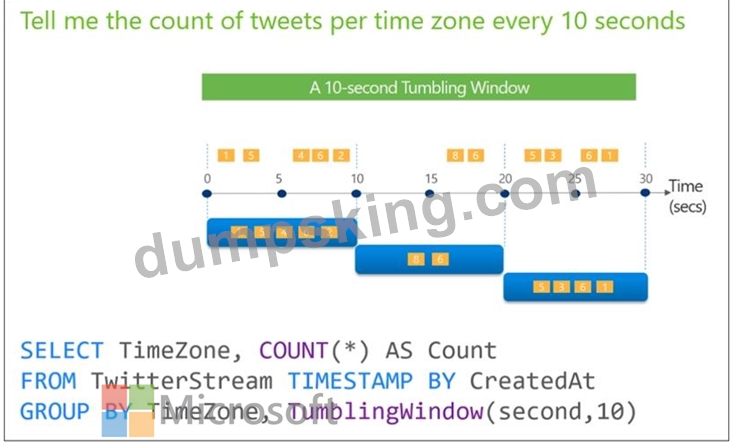
Reference:
https://docs.microsoft.com/en-us/stream-analytics-query/session-window-azure-stream-analytics
https://docs.microsoft.com/en-us/stream-analytics-query/tumbling-window-azure-stream-analytics
NEW QUESTION # 168
You have an Azure Synapse Analytics workspace that contains three pipelines and three triggers named Trigger 1. Trigger2, and Tiigger3.
Trigger 3 has the following definition.

Answer:
Explanation:
Explanation:
NEW QUESTION # 169
You need to design a data retention solution for the Twitter teed data records. The solution must meet the customer sentiment analytics requirements.
Which Azure Storage functionality should you include in the solution?
- A. change feed
- B. Iifecycle management
- C. soft delete
- D. time-based retention
Answer: B
NEW QUESTION # 170
You have an Azure Synapse Analytics dedicated SQL pool.
You need to ensure that data in the pool is encrypted at rest. The solution must NOT require modifying applications that query the data.
What should you do?
- A. Use a customer-managed key to enable double encryption for the Azure Synapse workspace.
- B. Enable Transparent Data Encryption (TDE) for the pool.
- C. Enable encryption at rest for the Azure Data Lake Storage Gen2 account.
- D. Create an Azure key vault in the Azure subscription grant access to the pool.
Answer: B
Explanation:
Explanation
Transparent Data Encryption (TDE) helps protect against the threat of malicious activity by encrypting and decrypting your data at rest. When you encrypt your database, associated backups and transaction log files are encrypted without requiring any changes to your applications. TDE encrypts the storage of an entire database by using a symmetric key called the database encryption key.
Reference:
https://docs.microsoft.com/en-us/azure/synapse-analytics/sql-data-warehouse/sql-data-warehouse-overviewmana
Topic 1, Litware, inc.
Case study
This is a case study. Case studies are not timed separately. You can use as much exam time as you would like to complete each case. However, there may be additional case studies and sections on this exam. You must manage your time to ensure that you are able to complete all questions included on this exam in the time provided.
To answer the questions included in a case study, you will need to reference information that is provided in the case study. Case studies might contain exhibits and other resources that provide more information about the scenario that is described in the case study. Each question is independent of the other questions in this case study.
At the end of this case study, a review screen will appear. This screen allows you to review your answers and to make changes before you move to the next section of the exam. After you begin a new section, you cannot return to this section.
To start the case study
To display the first question in this case study, click the button. Use the buttons in the left pane to explore the content of the case study before you answer the questions. Clicking these buttons displays information such as business requirements, existing environment, and problem statements. If the case study has an All Information tab, note that the information displayed is identical to the information displayed on the subsequent tabs. When you are ready to answer a question, click the button to return to the question.
Overview
Litware, Inc. owns and operates 300 convenience stores across the US. The company sells a variety of packaged foods and drinks, as well as a variety of prepared foods, such as sandwiches and pizzas.
Litware has a loyalty club whereby members can get daily discounts on specific items by providing their membership number at checkout.
Litware employs business analysts who prefer to analyze data by using Microsoft Power BI, and data scientists who prefer analyzing data in Azure Databricks notebooks.
Requirements
Business Goals
Litware wants to create a new analytics environment in Azure to meet the following requirements:
* See inventory levels across the stores. Data must be updated as close to real time as possible.
* Execute ad hoc analytical queries on historical data to identify whether the loyalty club discounts increase sales of the discounted products.
* Every four hours, notify store employees about how many prepared food items to produce based on historical demand from the sales data.
Technical Requirements
Litware identifies the following technical requirements:
* Minimize the number of different Azure services needed to achieve the business goals.
* Use platform as a service (PaaS) offerings whenever possible and avoid having to provision virtual machines that must be managed by Litware.
* Ensure that the analytical data store is accessible only to the company's on-premises network and Azure services.
* Use Azure Active Directory (Azure AD) authentication whenever possible.
* Use the principle of least privilege when designing security.
* Stage Inventory data in Azure Data Lake Storage Gen2 before loading the data into the analytical data store. Litware wants to remove transient data from Data Lake Storage once the data is no longer in use.
Files that have a modified date that is older than 14 days must be removed.
* Limit the business analysts' access to customer contact information, such as phone numbers, because this type of data is not analytically relevant.
* Ensure that you can quickly restore a copy of the analytical data store within one hour in the event of corruption or accidental deletion.
Planned Environment
Litware plans to implement the following environment:
* The application development team will create an Azure event hub to receive real-time sales data, including store number, date, time, product ID, customer loyalty number, price, and discount amount, from the point of sale (POS) system and output the data to data storage in Azure.
* Customer data, including name, contact information, and loyalty number, comes from Salesforce, a SaaS application, and can be imported into Azure once every eight hours. Row modified dates are not trusted in the source table.
* Product data, including product ID, name, and category, comes from Salesforce and can be imported into Azure once every eight hours. Row modified dates are not trusted in the source table.
* Daily inventory data comes from a Microsoft SQL server located on a private network.
* Litware currently has 5 TB of historical sales data and 100 GB of customer data. The company expects approximately 100 GB of new data per month for the next year.
* Litware will build a custom application named FoodPrep to provide store employees with the calculation results of how many prepared food items to produce every four hours.
* Litware does not plan to implement Azure ExpressRoute or a VPN between the on-premises network and Azure.
NEW QUESTION # 171
You have an Azure Synapse Analytics dedicated SQL pool mat contains a table named dbo.Users.
You need to prevent a group of users from reading user email addresses from dbo.Users. What should you use?
- A. Dynamic data masking
- B. column-level security
- C. row-level security
- D. Transparent Data Encryption (TDD
Answer: B
NEW QUESTION # 172
......
The DP-203 exam is a challenging exam that requires candidates to have a solid understanding of data engineering concepts, Azure services, and data processing workflows. Candidates who successfully pass DP-203 exam will have a valuable certification that can help them advance their careers in data engineering. Additionally, organizations that employ data engineers with this certification can be assured that they have the necessary skills to design and implement effective data solutions on Microsoft Azure.
Use Valid New DP-203 Test Notes & DP-203 Valid Exam Guide: https://dumpstorrent.dumpsking.com/DP-203-testking-dumps.html
