

[2025] DP-203 Actual Exam Dumps, DP-203 Practice Test
DumpsKing DP-203 dumps & Microsoft Certified: Azure Data Engineer Associate sure practice dumps
Microsoft DP-203 (Data Engineering on Microsoft Azure) Certification Exam is designed to test an individual's knowledge and skills in data engineering using Microsoft Azure. Data Engineering on Microsoft Azure certification is ideal for individuals who work with data and have experience with Azure services such as Azure Synapse Analytics, Azure Data Factory, Azure Databricks, and Azure Stream Analytics. DP-203 exam is intended to validate the candidate's ability to design, implement, and maintain data processing solutions using Microsoft's cloud platform.
Learn about the benefits of Microsoft DP-203 Certification
Microsoft DP-203 certification is a professional certification given to the candidates who successfully complete the DP-203 exam. Microsoft Data Platform with Hadoop Developer 203: Administration certification is an international standard for demonstrating competence in data platform administration. The exam validates the candidate's ability to administer and develop data platforms on the cloud-based environment of Microsoft Azure. The DP-203 certification is a globally recognized credential that can enable you to stand out from your peers and make your career more rewarding. The DP-203 course will help you to become a specialist who is able to manage, maintain and develop applications running on Hadoop frameworks on the Azure cloud platform. Microsoft DP-203 Dumps is designed to achieve your goal. The DP-203 training course covers the fundamental concepts of cloud computing, creating and managing virtual machines, storage accounts, load balancers, web and worker roles, databases, HDInsight, etc. It also covers how to implement security infrastructure and management of virtual networks using PowerShell commands. You will receive lifetime access to the content along with practice exam questions from real exams after each module. The DP-203 course provides an opportunity for career advancement as it enables you to enhance your expertise in developing solutions with the Hadoop framework and other data sources using the Microsoft Azure cloud platform. It will also help you boost your proficiency in implementing. Correct mapping and auditing exception testing for data.
Microsoft DP-203 or Data Engineering on Microsoft Azure Exam is one of the most sought-after certifications for professionals working in the field of data engineering. It is an associate-level exam that validates a candidate's knowledge and skills in designing and implementing data solutions on Microsoft Azure. DP-203 exam measures the candidate's ability to work with various Azure data services, including Azure Cosmos DB, Azure Stream Analytics, Azure Data Factory, and Azure Databricks.
NEW QUESTION # 107
You need to implement an Azure Synapse Analytics database object for storing the sales transactions data.
The solution must meet the sales transaction dataset requirements.
What solution must meet the sales transaction dataset requirements.
What should you do? To answer, select the appropriate options in the answer area.
NOTE: Each correct selection is worth one point.
Answer:
Explanation:
Explanation:
Box 1: Create table
Scenario: Load the sales transaction dataset to Azure Synapse Analytics Box 2: RANGE RIGHT FOR VALUES Scenario: Partition data that contains sales transaction records. Partitions must be designed to provide efficient loads by month. Boundary values must belong to the partition on the right.
RANGE RIGHT: Specifies the boundary value belongs to the partition on the right (higher values).
FOR VALUES ( boundary_value [,...n] ): Specifies the boundary values for the partition.
Scenario: Load the sales transaction dataset to Azure Synapse Analytics.
Contoso identifies the following requirements for the sales transaction dataset:
Partition data that contains sales transaction records. Partitions must be designed to provide efficient loads by month. Boundary values must belong to the partition on the right.
Ensure that queries joining and filtering sales transaction records based on product ID complete as quickly as possible.
Implement a surrogate key to account for changes to the retail store addresses.
Ensure that data storage costs and performance are predictable.
Minimize how long it takes to remove old records.
Reference:
https://docs.microsoft.com/en-us/sql/t-sql/statements/create-table-azure-sql-data-warehouse
NEW QUESTION # 108
You are designing a highly available Azure Data Lake Storage solution that will include geo-zone-redundant storage (GZRS).
You need to monitor for replication delays that can affect the recovery point objective (RPO).
What should you include in the monitoring solution?
- A. 5xx: Server Error errors
- B. availability
- C. Last Sync Time
- D. Average Success E2E Latency
Answer: C
Explanation:
Explanation
Because geo-replication is asynchronous, it is possible that data written to the primary region has not yet been written to the secondary region at the time an outage occurs. The Last Sync Time property indicates the last time that data from the primary region was written successfully to the secondary region. All writes made to the primary region before the last sync time are available to be read from the secondary location. Writes made to the primary region after the last sync time property may or may not be available for reads yet.
Reference:
https://docs.microsoft.com/en-us/azure/storage/common/last-sync-time-get
NEW QUESTION # 109
You are designing an application that will store petabytes of medical imaging data When the data is first created, the data will be accessed frequently during the first week. After one month, the data must be accessible within 30 seconds, but files will be accessed infrequently. After one year, the data will be accessed infrequently but must be accessible within five minutes.
You need to select a storage strategy for the dat
a. The solution must minimize costs.
Which storage tier should you use for each time frame? To answer, select the appropriate options in the answer area.
NOTE: Each correct selection is worth one point.
Answer:
Explanation:
References:
https://docs.microsoft.com/en-us/azure/storage/blobs/storage-blob-storage-tiers
NEW QUESTION # 110
You have an Azure subscription.
You need to deploy an Azure Data Lake Storage Gen2 Premium account. The solution must meet the following requirements:
* Blobs that are older than 365 days must be deleted.
* Administrator efforts must be minimized.
* Costs must be minimized
What should you use? To answer, select the appropriate options in the answer are a. NOTE Each correct selection is worth one point.
Answer:
Explanation:
NEW QUESTION # 111
You have an Azure subscription that contains an Azure Synapse Analytics dedicated SQL pool. You plan to deploy a solution that will analyze sales data and include the following:
* A table named Country that will contain 195 rows
* A table named Sales that will contain 100 million rows
* A query to identify total sales by country and customer from the past 30 days You need to create the tables. The solution must maximize query performance.
How should you complete the script? To answer, select the appropriate options in the answer area.
NOTE: Each correct selection is worth one point.
Answer:
Explanation:
NEW QUESTION # 112
You have an Azure Synapse Analytics dedicated SQL pool.
You need to ensure that data in the pool is encrypted at rest. The solution must NOT require modifying applications that query the data.
What should you do?
- A. Enable encryption at rest for the Azure Data Lake Storage Gen2 account.
- B. Create an Azure key vault in the Azure subscription grant access to the pool.
- C. Enable Transparent Data Encryption (TDE) for the pool.
- D. Use a customer-managed key to enable double encryption for the Azure Synapse workspace.
Answer: C
Explanation:
Transparent Data Encryption (TDE) helps protect against the threat of malicious activity by encrypting and decrypting your data at rest. When you encrypt your database, associated backups and transaction log files are encrypted without requiring any changes to your applications. TDE encrypts the storage of an entire database by using a symmetric key called the database encryption key.
Reference:
https://docs.microsoft.com/en-us/azure/synapse-analytics/sql-data-warehouse/sql-data-warehouse-overviewmanage-security
NEW QUESTION # 113
You have an Azure subscription that contains the resources shown in the following table.
You need to ingest the Parquet files from storage1 to SQL1 by using pipeline1. The solution must meet the following requirements:
* Minimize complexity.
* Ensure that additional columns in the files are processed as strings.
* Ensure that files containing additional columns are processed successfully.
How should you configure pipeline1? To answer, select the appropriate options in the answer area.
NOTE: Each correct selection is worth one point.
Answer:
Explanation:
NEW QUESTION # 114
You have an Azure Synapse Analytics dedicated SQL pool named Pcol1. Pool1 contains a table named tablet You load 5 TB of data into table1.
You need to ensure that column store compression is maximized for table1.
Which statement should you execute?
- A. ALTER INDEX ALL on table REORGANIZE
- B. DBCC IIDEXDEFRAG (pool1, table1)
- C. ALTER INDEX ALL on table REBUILD
- D. DBCC DBREINOEX (table)
Answer: D
Explanation:
Topic 2, Litware, inc. Case Study
Case study
This is a case study. Case studies are not timed separately. You can use as much exam time as you would like to complete each case. However, there may be additional case studies and sections on this exam. You must manage your time to ensure that you are able to complete all questions included on this exam in the time provided.
To answer the questions included in a case study, you will need to reference information that is provided in the case study. Case studies might contain exhibits and other resources that provide more information about the scenario that is described in the case study. Each question is independent of the other questions in this case study.
At the end of this case study, a review screen will appear. This screen allows you to review your answers and to make changes before you move to the next section of the exam. After you begin a new section, you cannot return to this section.
To start the case study
To display the first question in this case study, click the Next button. Use the buttons in the left pane to explore the content of the case study before you answer the questions. Clicking these buttons displays information such as business requirements, existing environment, and problem statements. If the case study has an All Information tab, note that the information displayed is identical to the information displayed on the subsequent tabs. When you are ready to answer a question, click the Question button to return to the question.
Overview
Litware, Inc. owns and operates 300 convenience stores across the US. The company sells a variety of packaged foods and drinks, as well as a variety of prepared foods, such as sandwiches and pizzas.
Litware has a loyalty club whereby members can get daily discounts on specific items by providing their membership number at checkout.
Litware employs business analysts who prefer to analyze data by using Microsoft Power BI, and data scientists who prefer analyzing data in Azure Databricks notebooks.
Requirements
Business Goals
Litware wants to create a new analytics environment in Azure to meet the following requirements:
See inventory levels across the stores. Data must be updated as close to real time as possible.
Execute ad hoc analytical queries on historical data to identify whether the loyalty club discounts increase sales of the discounted products.
Every four hours, notify store employees about how many prepared food items to produce based on historical demand from the sales data.
Technical Requirements
Litware identifies the following technical requirements:
Minimize the number of different Azure services needed to achieve the business goals.
Use platform as a service (PaaS) offerings whenever possible and avoid having to provision virtual machines that must be managed by Litware.
Ensure that the analytical data store is accessible only to the company's on-premises network and Azure services.
Use Azure Active Directory (Azure AD) authentication whenever possible.
Use the principle of least privilege when designing security.
Stage Inventory data in Azure Data Lake Storage Gen2 before loading the data into the analytical data store.
Litware wants to remove transient data from Data Lake Storage once the data is no longer in use. Files that have a modified date that is older than 14 days must be removed.
Limit the business analysts' access to customer contact information, such as phone numbers, because this type of data is not analytically relevant.
Ensure that you can quickly restore a copy of the analytical data store within one hour in the event of corruption or accidental deletion.
Planned Environment
Litware plans to implement the following environment:
The application development team will create an Azure event hub to receive real-time sales data, including store number, date, time, product ID, customer loyalty number, price, and discount amount, from the point of sale (POS) system and output the data to data storage in Azure.
Customer data, including name, contact information, and loyalty number, comes from Salesforce, a SaaS application, and can be imported into Azure once every eight hours. Row modified dates are not trusted in the source table.
Product data, including product ID, name, and category, comes from Salesforce and can be imported into Azure once every eight hours. Row modified dates are not trusted in the source table.
Daily inventory data comes from a Microsoft SQL server located on a private network.
Litware currently has 5 TB of historical sales data and 100 GB of customer data. The company expects approximately 100 GB of new data per month for the next year.
Litware will build a custom application named FoodPrep to provide store employees with the calculation results of how many prepared food items to produce every four hours.
Litware does not plan to implement Azure ExpressRoute or a VPN between the on-premises network and Azure.
NEW QUESTION # 115
You have an Azure Synapse serverless SQL pool.
You need to read JSON documents from a file by using the OPENROWSET function.
How should you complete the query? To answer, select the appropriate options in the answer area.
NOTE: Each correct selection is worth one point.
Answer:
Explanation:
Explanation:
NEW QUESTION # 116
You have an Azure subscription.
You plan to build a data warehouse in an Azure Synapse Analytics dedicated SQL pool named pool1 that will contain staging tables and a dimensional model. Pool1 will contain the following tables.
You need to design the table storage for pool1. The solution must meet the following requirements:
Maximize the performance of data loading operations to Staging.WebSessions.
Minimize query times for reporting queries against the dimensional model.
Which type of table distribution should you use for each table? To answer, drag the appropriate table distribution types to the correct tables. Each table distribution type may be used once, more than once, or not at all. You may need to drag the split bar between panes or scroll to view content.
NOTE: Each correct selection is worth one point.
Answer:
Explanation:
Explanation:
Box 1: Replicated
The best table storage option for a small table is to replicate it across all the Compute nodes.
Box 2: Hash
Hash-distribution improves query performance on large fact tables.
Box 3: Round-robin
Round-robin distribution is useful for improving loading speed.
Reference: https://docs.microsoft.com/en-us/azure/synapse-analytics/sql-data-warehouse/sql-data-warehouse- tables-distribute
NEW QUESTION # 117
You are designing a slowly changing dimension (SCD) for supplier data in an Azure Synapse Analytics dedicated SQL pool.
You plan to keep a record of changes to the available fields.
The supplier data contains the following columns.
Which three additional columns should you add to the data to create a Type 2 SCD? Each correct answer presents part of the solution.
NOTE: Each correct selection is worth one point.
- A. surrogate primary key
- B. last modified date
- C. business key
- D. effective start date
- E. foreign key
- F. effective end date
Answer: A,D,F
Explanation:
Reference:
https://docs.microsoft.com/en-us/sql/integration-services/data-flow/transformations/slowly-changing-dimension-
NEW QUESTION # 118
You are building an Azure Analytics query that will receive input data from Azure IoT Hub and write the results to Azure Blob storage.
You need to calculate the difference in readings per sensor per hour.
How should you complete the query? To answer, select the appropriate options in the answer area.
NOTE: Each correct selection is worth one point.
Answer:
Explanation:
Reference:
https://docs.microsoft.com/en-us/stream-analytics-query/lag-azure-stream-analytics
NEW QUESTION # 119
You need to design a data ingestion and storage solution for the Twitter feeds. The solution must meet the customer sentiment analytics requirements.
What should you include in the solution? To answer, select the appropriate options in the answer area NOTE: Each correct selection b worth one point.
Answer:
Explanation:
Explanation
Graphical user interface, text Description automatically generated
Box 1: Configure Evegent Hubs partitions
Scenario: Maximize the throughput of ingesting Twitter feeds from Event Hubs to Azure Storage without purchasing additional throughput or capacity units.
Event Hubs is designed to help with processing of large volumes of events. Event Hubs throughput is scaled by using partitions and throughput-unit allocations.
Event Hubs traffic is controlled by TUs (standard tier). Auto-inflate enables you to start small with the minimum required TUs you choose. The feature then scales automatically to the maximum limit of TUs you need, depending on the increase in your traffic.
Box 2: An Azure Data Lake Storage Gen2 account
Scenario: Ensure that the data store supports Azure AD-based access control down to the object level.
Azure Data Lake Storage Gen2 implements an access control model that supports both Azure role-based access control (Azure RBAC) and POSIX-like access control lists (ACLs).
Reference:
https://docs.microsoft.com/en-us/azure/event-hubs/event-hubs-features
https://docs.microsoft.com/en-us/azure/storage/blobs/data-lake-storage-access-control
NEW QUESTION # 120
You have an Apache Spark DataFrame named temperatures. A sample of the data is shown in the following table.
You need to produce the following table by using a Spark SQL query.
How should you complete the query? To answer, drag the appropriate values to the correct targets. Each value may be used once, more than once, or not at all. You may need to drag the split bar between panes or scroll to view content.
NOTE: Each correct selection is worth one point.
Answer:
Explanation:
Explanation
Text Description automatically generated
Box 1: PIVOT
PIVOT rotates a table-valued expression by turning the unique values from one column in the expression into multiple columns in the output. And PIVOT runs aggregations where they're required on any remaining column values that are wanted in the final output.
Reference:
https://learnsql.com/cookbook/how-to-convert-an-integer-to-a-decimal-in-sql-server/
https://docs.microsoft.com/en-us/sql/t-sql/queries/from-using-pivot-and-unpivot
NEW QUESTION # 121
You are designing an Azure Stream Analytics solution that receives instant messaging data from an Azure Event Hub.
You need to ensure that the output from the Stream Analytics job counts the number of messages per time zone every 15 seconds.
How should you complete the Stream Analytics query? To answer, select the appropriate options in the answer area.
NOTE: Each correct selection is worth one point.
Answer:
Explanation:
Explanation
Table Description automatically generated
Box 1: timestamp by
Box 2: TUMBLINGWINDOW
Tumbling window functions are used to segment a data stream into distinct time segments and perform a function against them, such as the example below. The key differentiators of a Tumbling window are that they repeat, do not overlap, and an event cannot belong to more than one tumbling window.
Timeline Description automatically generated
Reference:
https://docs.microsoft.com/en-us/azure/stream-analytics/stream-analytics-window-functions
NEW QUESTION # 122
You have an Azure subscription that contains an Azure Synapse Analytics dedicated SQL pool. You plan to deploy a solution that will analyze sales data and include the following:
* A table named Country that will contain 195 rows
* A table named Sales that will contain 100 million rows
* A query to identify total sales by country and customer from the past 30 days You need to create the tables. The solution must maximize query performance.
How should you complete the script? To answer, select the appropriate options in the answer area.
NOTE: Each correct selection is worth one point.
Answer:
Explanation:
NEW QUESTION # 123
You have a Microsoft Purview account. The Lineage view of a CSV file is shown in the following exhibit.
How is the data for the lineage populated?
- A. by scanning data stores
- B. manually
- C. by executing a Data Factory pipeline
Answer: A
Explanation:
According to Microsoft Purview Data Catalog lineage user guide1, data lineage in Microsoft Purview is a core platform capability that populates the Microsoft Purview Data Map with data movement and transformations across systems2. Lineage is captured as it flows in the enterprise and stitched without gaps irrespective of its source2.
NEW QUESTION # 124
You have the following Azure Stream Analytics query.
For each of the following statements, select Yes if the statement is true. Otherwise, select No.
NOTE: Each correct selection is worth one point.
Answer:
Explanation:
Explanation:
Box 1: No
Note: You can now use a new extension of Azure Stream Analytics SQL to specify the number of partitions of a stream when reshuffling the data.
The outcome is a stream that has the same partition scheme. Please see below for an example:
WITH step1 AS (SELECT * FROM [input1] PARTITION BY DeviceID INTO 10),
step2 AS (SELECT * FROM [input2] PARTITION BY DeviceID INTO 10)
SELECT * INTO [output] FROM step1 PARTITION BY DeviceID UNION step2 PARTITION BY DeviceID Note: The new extension of Azure Stream Analytics SQL includes a keyword INTO that allows you to specify the number of partitions for a stream when performing reshuffling using a PARTITION BY statement.
Box 2: Yes
When joining two streams of data explicitly repartitioned, these streams must have the same partition key and partition count.
Box 3: Yes
Streaming Units (SUs) represents the computing resources that are allocated to execute a Stream Analytics job. The higher the number of SUs, the more CPU and memory resources are allocated for your job.
In general, the best practice is to start with 6 SUs for queries that don't use PARTITION BY.
Here there are 10 partitions, so 6x10 = 60 SUs is good.
Note: Remember, Streaming Unit (SU) count, which is the unit of scale for Azure Stream Analytics, must be adjusted so the number of physical resources available to the job can fit the partitioned flow. In general, six SUs is a good number to assign to each partition. In case there are insufficient resources assigned to the job, the system will only apply the repartition if it benefits the job.
Reference:
https://azure.microsoft.com/en-in/blog/maximize-throughput-with-repartitioning-in-azure-stream-analytics/
https://docs.microsoft.com/en-us/azure/stream-analytics/stream-analytics-streaming-unit-consumption
NEW QUESTION # 125
You have an Azure Synapse workspace named MyWorkspace that contains an Apache Spark database named mytestdb.
You run the following command in an Azure Synapse Analytics Spark pool in MyWorkspace.
CREATE TABLE mytestdb.myParquetTable(
EmployeeID int,
EmployeeName string,
EmployeeStartDate date)
USING Parquet
You then use Spark to insert a row into mytestdb.myParquetTable. The row contains the following dat a.
One minute later, you execute the following query from a serverless SQL pool in MyWorkspace.
SELECT EmployeeID
FROM mytestdb.dbo.myParquetTable
WHERE name = 'Alice';
What will be returned by the query?
- A. 0
- B. a null value
- C. an error
Answer: A
Explanation:
Once a database has been created by a Spark job, you can create tables in it with Spark that use Parquet as the storage format. Table names will be converted to lower case and need to be queried using the lower case name. These tables will immediately become available for querying by any of the Azure Synapse workspace Spark pools. They can also be used from any of the Spark jobs subject to permissions.
Note: For external tables, since they are synchronized to serverless SQL pool asynchronously, there will be a delay until they appear.
Reference:
https://docs.microsoft.com/en-us/azure/synapse-analytics/metadata/table
NEW QUESTION # 126
You have an Azure Data Lake Storage Gen 2 account named storage1.
You need to recommend a solution for accessing the content in storage1. The solution must meet the following requirements:
* List and read permissions must be granted at the storage account level.
* Additional permissions can be applied to individual objects in storage1.
* Security principals from Microsoft Azure Active Directory (Azure AD), part of Microsoft Entra, must be used for authentication.
What should you use? To answer, drag the appropriate components to the correct requirements. Each component may be used once, more than once, or not at all. You may need to drag the split bar between panes or scroll to view content.
NOTE: Each correct selection is worth one point.
Answer:
Explanation:
Explanation
Box 1: Role-based access control (RBAC) roles
List and read permissions must be granted at the storage account level.
Security principals from Microsoft Azure Active Directory (Azure AD), part of Microsoft Entra, must be used for authentication.
Role-based access control (Azure RBAC)
Azure RBAC uses role assignments to apply sets of permissions to security principals. A security principal is an object that represents a user, group, service principal, or managed identity that is defined in Azure Active Directory (AD). A permission set can give a security principal a "coarse-grain" level of access such as read or write access to all of the data in a storage account or all of the data in a container.
Box 2: Access control lists (ACLs)
Additional permissions can be applied to individual objects in storage1.
Access control lists (ACLs)
ACLs give you the ability to apply "finer grain" level of access to directories and files. An ACL is a permission construct that contains a series of ACL entries. Each ACL entry associates security principal with an access level.
Reference: https://learn.microsoft.com/en-us/azure/storage/blobs/data-lake-storage-access-control-model
NEW QUESTION # 127
You have an Azure event hub named retailhub that has 16 partitions. Transactions are posted to retailhub. Each transaction includes the transaction ID, the individual line items, and the payment details. The transaction ID is used as the partition key.
You are designing an Azure Stream Analytics job to identify potentially fraudulent transactions at a retail store. The job will use retailhub as the input. The job will output the transaction ID, the individual line items, the payment details, a fraud score, and a fraud indicator.
You plan to send the output to an Azure event hub named fraudhub.
You need to ensure that the fraud detection solution is highly scalable and processes transactions as quickly as possible.
How should you structure the output of the Stream Analytics job? To answer, select the appropriate options in the answer area.
NOTE: Each correct selection is worth one point.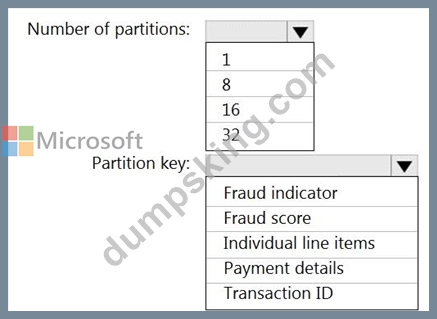
Answer:
Explanation:
Reference:
https://docs.microsoft.com/en-us/azure/event-hubs/event-hubs-features#partitions
NEW QUESTION # 128
You plan to create a real-time monitoring app that alerts users when a device travels more than 200 meters away from a designated location.
You need to design an Azure Stream Analytics job to process the data for the planned app. The solution must minimize the amount of code developed and the number of technologies used.
What should you include in the Stream Analytics job? To answer, select the appropriate options in the answer area.
NOTE: Each correct selection is worth one point.
Answer:
Explanation:
Explanation
Diagram, table Description automatically generated
Input type: Stream
You can process real-time IoT data streams with Azure Stream Analytics.
Function: Geospatial
With built-in geospatial functions, you can use Azure Stream Analytics to build applications for scenarios such as fleet management, ride sharing, connected cars, and asset tracking.
Note: In a real-world scenario, you could have hundreds of these sensors generating events as a stream.
Ideally, a gateway device would run code to push these events to Azure Event Hubs or Azure IoT Hubs.
Reference:
https://docs.microsoft.com/en-us/azure/stream-analytics/stream-analytics-get-started-with-azure-stream-analytics
https://docs.microsoft.com/en-us/azure/stream-analytics/geospatial-scenarios
NEW QUESTION # 129
......
DP-203 Actual Questions and Braindumps: https://dumpstorrent.dumpsking.com/DP-203-testking-dumps.html
